The Svesani Treasure: the Gold of the South Danube Dacians
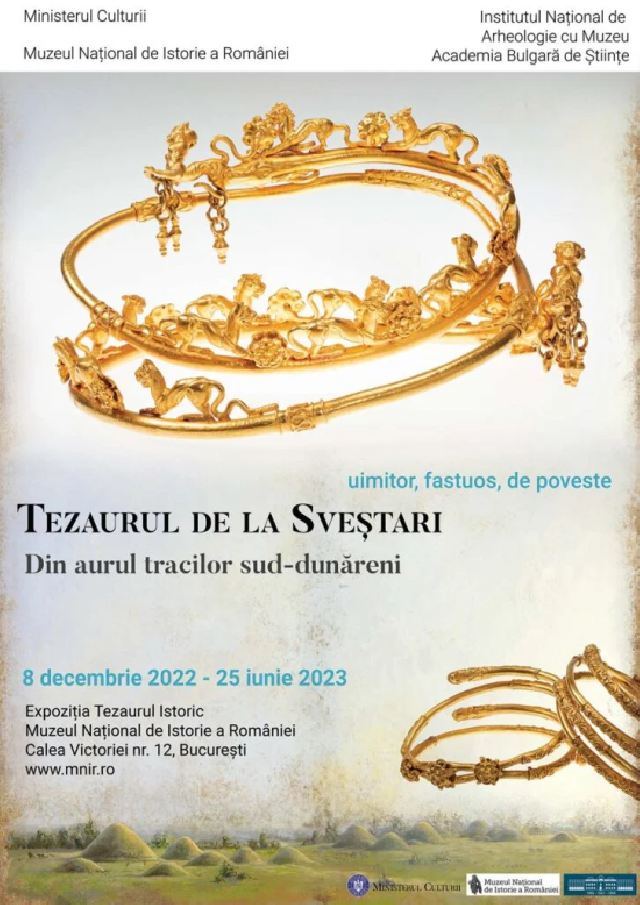
The Romanian National History Museum in Bucharest recently opened a special exhibition, The Svesani Treasure: the Gold of the South Danube Dacians
Ion Puican, 31.12.2022, 14:00
The Romanian National History Museum in Bucharest recently opened a special exhibition, The Svesani Treasure: the Gold of the South Danube Dacians. It resumes the history museum cooperation in archaeology between Romania and its neighboring Bulgaria.
The Svestari Treasure, located in northeast Bulgaria, was discovered in November 2012 in the tumumuls necropolis of a fortified city, built in the 6th century BCE. We spoke about this collaboration with the manager of the history museum, Ernest Oberlander-Tarnoveanu:
“After a gap of 45 years, the Romanian National History Museum and the National Archaeology Institute and Museum in Sofia resumed their collaboration. This year in April, a grand exhibition was opened in Sofia, at the institute museum, on the weaponry of Thracian elites. On this occasion, the Romanian National History Museum and the Institute of Eco-Museal Studies in Tulcea were present with rich exhibitions with pieces from the princely tomb in Agighiol, dating back to the 4th century BCE. In reply to this exhibition, in Bucharest we opened a wonderful exhibition with pieces from one of the royal tombs in Svestari. This exhibition is part of a larger theme, because the Romanian National History Museum opened the exhibition called Dacia, the Last Frontier of the Romans. Together with the Historic Treasure, together with the copy of Trajan’s Column, this exhibition of gold pieces from the Getae area south of the Danube, this is a valued addition, allowing the visitors to know a special aspect of the Getae arts and civilization, who were part of the Thracian world, just as the Dacians. We thought that the best place for these superb gold jewelry would be the Thesaurus. Meaning that the exhibits form Svestari should be next to their cousins uncovered in Romania.
We asked Ernest Oberlander-Tarnoveanu what the public can expect from the exhibition, what is special about the treasure, and what made this discovery extraordinary:
“I would start with the site, this is one of the largest centers south of the Danube. Bulgarian archaeologists and historians, and many of our Romanian colleagues, believe that this city was Helis, the capital of warlord Dromichaites. We believe that this is the site of events described by Diodorus of Sicily, the meeting between Dromichaites and King Lysimachus and his sons, after their defeat in battle. All around this site, in the middle of wonderful surroundings, we have a tumulus necropolis with large size tumuli. One of these was researched by Bulgarian archaeologist Diana Gheorghiev, and they had amazing luck. They found a situation which is rare to come across in our business. Within the casing of the tomb there was a natural relic, a giant ancient oak. For Indo-Europeans, the oak was a tree consecrated to a father of the gods figure, like Zeus. In the branches of the oak they found a wooden casket, containing both women’s jewelry and pieces of horse tackle. The tumulus was a tomb with a stone structure, and a chamber with a vaulted ceiling, which was a major innovation for the late 4th century, early 3rd century BCE. What we know for sure is that two people were buried there, and they had a connection with the treasure. For the first time, archaeologists were able to document the fact that a royal tomb was built around a sacred tree. Therefore, the place itself became sacred, and the people buried there were placed under the highest possible protection of the father of the gods. The treasure, as the visitors can see, consists female jewelry, diadems and bracelets decorated with mythological and fantastic animals, such as griffins and lion heads. We also have pieces of horse tackle. So we have, on the one hand a feminine offering, and on the other, a masculine offering. From all we know right now from royal tomb discoveries, it seems very clear that these were Thracian elites, be they at the mouths of the Danube, in Agighiol, be they in the Wallachian Plains, at Peretu, and many other places. However, these two discoveries are special, it shows that they believed in life after death, which continued with the same elements as their earthly life. In their earthly life, they were warlords, and the horse was part of their royal presence. This nameless king put in gold decorations for his favorite horse, and his wife put in jewelry. Certainly, you could not face the gods without such an obvious mark of the social position you had on earth than gold decorations.
We asked the manager of the Romanian National History Museum in Bucharest what is unique and valuable about the treasure found in Bulgaria:
“These were crafted in Greek workshops in the best ancient tradition, because by the 4th century, the Getae had been in contact with the Greeks for a long time, and had borrowed important elements of Greek civilization. They certainly appreciated these high craftsmanship pieces. As we can see, they adorned kings. They were not for just everyone, and it is not very often to see such a discovery in a museum such as ours. This treasure from Svestari did not travel much abroad. The exhibition will be available to visitors until June. The encompassing exhibition, Dacia, Last Frontier of the Romans, which is on the same theme, will be available to the public until late May, because in June it is going to Italy, at the Roman National Museum, as part of a very important exhibition.