The Bulgarian story of the director who created “Rambo”
Ted Kotcheff dreamed of becoming a poet. Instead, he found his calling in cinema, directing Rambo: First Blood.
Radio România Internațional, 18.11.2026, 17:26
Ted Kotcheff dreamed of becoming a poet. Instead, he found his calling in cinema, directing Rambo: First Blood and working with some of the screen’s greatest actors. His career took him across continents and brought him international acclaim, but in interviews he kept returning to his childhood home in Toronto – a Bulgarian household that reminded him of the houses of Plovdiv. Born there on 7 April 1931 to Bulgarian immigrants, Kotcheff (1931-2025) grew up with stories, songs and a longing for a country he had yet to see.
In an interview with Olya Stoyanova for BNR’s Hristo Botev programme, preserved in BNR’s Golden Fund, he recalled that Bulgarian was spoken at home when he was a child, and that his mother, who lived in Canada for 70 years, never learned to speak English. This was how Bulgaria came into his life long before he ever saw it. He knew the country through his relatives’ stories, their love and their wish to return one day:
“I love Bulgaria. I am at home here. My dad was born in Plovdiv and grew up there. My mother was a Macedonian. They lived in Varna. And at home we lived just like in Bulgaria. The house was like a house in Plovdiv. We had a big Bulgarian family! My mother had a sister who lived with us, and a brother. My dad had a brother who lived with us. We had cousins, many cousins. And every Sunday everyone would come over, eat Bulgarian food, and then sing songs and cry. They wanted to return to Bulgaria, they didn’t want to be in cold Canada… And then they would join hands and dance a horo. They sang and danced all over the house. When I was little, they kept saying: ‘We will go back home, to Bulgaria, because we don’t like it here.’ And Uncle Georgi, my dad’s brother, used to say: ‘It’s cold here, and the people are cold too…’ They wanted to go back to Bulgaria, but then the war started and…”
Memories of the family home also came alive through Bulgarian songs, which Ted Kotcheff gladly began singing, even when the words escaped him:
“(Singing) ‘Your tie is red, your tie is red, your tie is red, dear mother…’ (Laughs.) I’ve forgotten the lyrics. I used to play the violin. I learned to play when I was five years old. My mother used to sing and play the mandolin. My father had a very fine singing voice. I used to say: ‘In my heart, in my soul, I am a Bulgarian… I am a Canadian, but also a Bulgarian. And when I come here, I am coming home.’”
Ted got his love of films from his father. After arriving in Canada, his dad worked as an usher in a cinema and later shared his passion with his son: several times a week, the two would watch two films in a row. One of the actresses little Ted admired was Ingrid Bergman. Years later, he met her on set – as her director in the television adaptation of Jean Cocteau’s The Human Voice. He recalled this in an interview with Paul Rowlands for the film blog Money into Light.
But all that was still ahead of him. Young Ted studied English literature at the University of Toronto and wanted to write poetry. His father worried about how he would make a living, because there was no money in poetry. Laughing, Ted replied that there was no poetry in money. Still, he decided to follow his father’s advice and looked for a job at CBC, whose television service was then taking its first steps. He started as a stagehand. Later, he got a chance to direct and threw himself into the new job. From Canadian television, his path led to Great Britain, where he worked in the theatre and took his first steps in feature filmmaking, and later to Australia.
In 1971, Wake in Fright earned him a place in the main competition at the Cannes Film Festival. In 1974, The Apprenticeship of Duddy Kravitz won the Golden Bear in Berlin and later received an Oscar nomination for its screenplay. This success established him as a major name in Canadian cinema. A new chapter in his career opened up – in Hollywood.
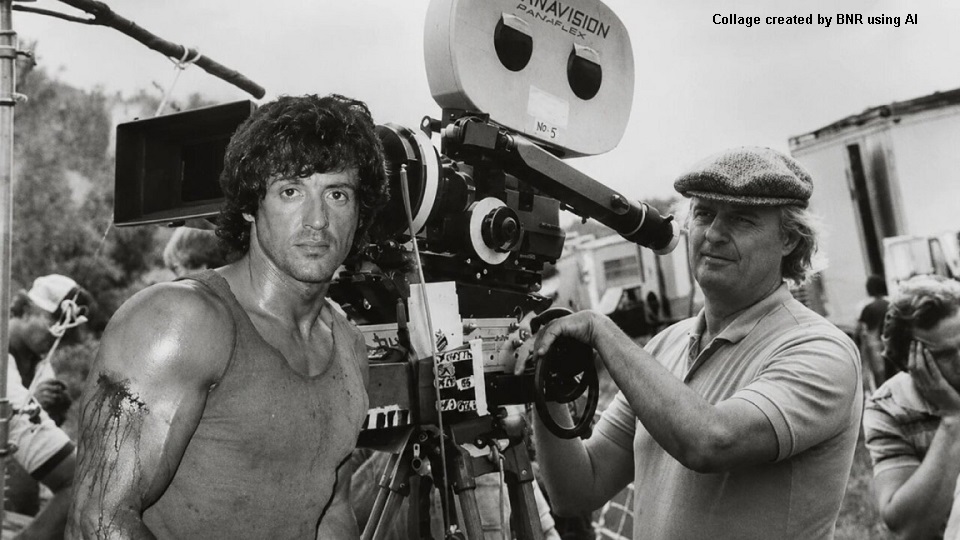
There, in 1982, he directed the legendary Rambo: First Blood, starring Sylvester Stallone. Behind the action lies a deeper story – the fate of Vietnam veterans, for whom returning from war did not mean returning to a normal life. Instead of being welcomed with gratitude, they were rejected by society.
Success could not keep Kotcheff tied to a single genre. His filmography includes the western Billy Two Hats, the sports drama North Dallas Forty and the dark comedy Weekend at Bernie’s… Television was also part of his life: for years, he was an executive producer and director of Law & Order: Special Victims Unit. How do you make the transition between such different genres? Here is how Kotcheff put it in his interview with Olya Stoyanova:
“Look, Rambo: First Blood with Sylvester Stallone. Rambo is running, Rambo is at the police station… People say that a comedy is not hard to make. How is it not hard? ‘Well, a comedy – that’s funny.’ OK! Say something to make me laugh. Do it, I’m waiting. The humour has to come naturally. Then I went into television, I filmed a live television drama… I’d shoot a drama, three weeks later – a comedy, three weeks later – a thriller, three weeks later – a historical drama. Then a comedy again. I learned how to work in all genres. And I love all of them. When I write, I think about life… I’ve had a very interesting life.”
“My first and greatest love is making films. The only thing I have never done is what people expected of me.” With these words from his autobiography, Ted Kotcheff summed up his life and work. Behind this artistic freedom, however, lay extraordinary attention to detail on set. For The Apprenticeship of Duddy Kravitz, Kotcheff spent a long time searching for a lake whose beauty would explain why the character was ready to do anything to own it. He approached the people he portrayed with the same care. When asked to direct an Alun Owen play about a working-class community in Liverpool, No Trams to Lime Street, he initially refused – as a Canadian, he didn’t know the community well enough. Later, the producer persuaded him to accept, but the director insisted on spending some time in the city first to get to know the setting.
That curiosity owed something to his childhood, growing up between a Bulgarian home and the Canadian world outside. Speaking to Brooklyn Magazine, Kotcheff linked his interest in people on the margins of society to his immigrant childhood. This experience helped him notice other people’s vulnerability and connect with those whose lives, at first glance, seemed completely different from everyone else’s.
When describing his perfect day, Kotcheff talked about the set. His pleasure lay in making the film itself – in communicating with the actors, in rehearsals, in the moment when a scene came to life. And when circumstances changed his plans, as with the 17-year ban on his entering the United States when he was young, he preferred to use the opportunities that opened up rather than dwell on what he had missed. “Thinking about such things is a waste of time. Whatever circumstances life hands you, you have to accept them and make the best of them,” Ted told Paul Rowlands.
Even in his later years, Kotcheff continued to return to Bulgaria – with affection and new plans. In 2016, at the age of 84, he received a certificate of Bulgarian citizenship – official confirmation of the sense of belonging he had carried throughout his life. A skilled storyteller both in front of the camera and in friendly conversation, he was in no rush to put an end to his creative plans. At 86, he was working on a film about Tsar Boris III and the rescue of the Bulgarian Jews, a project he had long dreamed of. Deeply committed, he dedicated his final years to this cause. However, the film remained unmade, with funding proving the main obstacle.
Meanwhile, the stories he loved telling friends and colleagues found their way into his autobiography. “We were discussing different titles until the publisher suggested Director’s Cut: My Life in Film. I thought that was very interesting, because when you make a movie, the first version is considered the director’s cut, and then, of course, all kinds of other people come along and try to make their own version. I rarely let that happen if I can prevent it,” Ted Kotcheff told Brooklyn Magazine in 2017.
When presenting the Bulgarian edition of his autobiography, Kotcheff recalled something: his father had dreamed of seeing their family name on the cover of a book one day. And so that dream came true.
Ted Kotcheff passed away at the age of 94. He leaves us his films, his stories and the laughter preserved in BNR’s Golden Fund. And there is the book, in which the wider world meets the Bulgarian home of his childhood. (author Miglena Ivanova)
This content is republished under a bilateral cooperation agreement between the Bulgarian National Radio (BNR) and the Romanian Radio Broadcasting Corporation (Radio România). The original article can be found on the Bulgarian National Radio website at the following link:
https://bnrnews.bg/en/post/558105/the-bulgarian-story-of-the-director-who-created-rambo