The Coțofenești Helmet
The Coțofenești helmet is one of the most valuable gold artifacts ever discovered on the territory of Romania, belonging to the Thraco-Getic civilization.
Ion Puican, 25.10.2026, 14:00
The Coțofenești helmet is one of the most valuable gold artifacts ever discovered on the territory of Romania, belonging to the Thraco-Getic civilization. It was found by chance around 1927–1928 by a child from the village of Coțofenești, in the commune of Vărbilău, Prahova County, in the southern part of the country. The boy, who was out grazing sheep, wore the helmet on his head for several weeks. The piece was subsequently sold and ended up in the hands of a local merchant. In April 1929, it was purchased by the Romanian state and entered the National Museum of Antiquities’ collection; it later became part of the collection of the National History Museum of Romania (MNIR) in Bucharest, where it remains to this day.
Museum curator Maria-Magdalena Ștefan, from the MNIR, tells us the story of this famous helmet: “The most significant discoveries about the world belong to children, and this is not merely a metaphor for the inquisitive spirit that defines humanity; it is also a literal truth, at least within the context of archaeology in Romania. The most famous cultural artifact in Romania today, the golden helmet from Coțofenești, as well as its counterpart from Cucuteni-Bădiceni, were discovered by children. We owe the 1928 discovery of the golden helmet, found on a wooded hillside in the Subcarpathian region, to a primary school boy, Traian Alexandru Simion, from the village of Coțofenești in Prahova County. We are located here not far from Vălenii de Munte, a site that once marked the beginning of a major transit route across the Carpathians. It is, therefore, no coincidence that such wealth was concentrated here, even if the area now appears wild and isolated. In those years, when the helmet first became known to the researchers of the time, most notably to university professor Ioan Andriescu, who conducted excavations at the discovery site in 1929, the Romanian public was still suffering from the loss of the “The Hatching Hen with Golden Chicks” (the Pietroasele treasure). At that time, the treasure had not yet returned from Russia, where it had been sent for safekeeping at the outbreak of the First World War; it seemed lost forever. Thus, the public life of the Coțofenești helmet began under the shadow of a collective sense of injustice and loss. From the very start, it was perceived as a symbolic form of restitution for what had previously been considered Romania’s most significant historical treasure. In the 98 years since its discovery, it has not only endured but has further solidified its status as a national symbol: it has appeared in the history textbooks used by generations of schoolchildren, and its image has even enjoyed a ‘cinematic career’”.
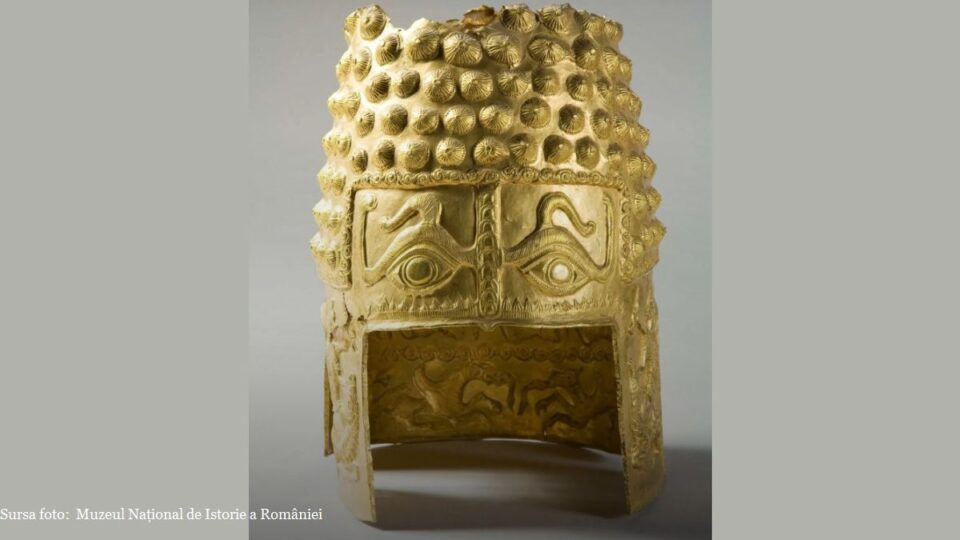
The helmet dates back to the 4th century BC and is crafted from high-purity gold, weighing 770 grams. Its surface features ritual scenes, large protective eyes, and fantastic animals, motifs typical of Thracian art, yet showing Greek and Scythian influences. Maria-Magdalena Ștefan provides further details on how this gold object was crafted and describes its decorations: “The helmet is a product of the metalworking art characteristic of the Thracians living north of the Balkan Mountains. Given the metal used and its decoration, the object appears to have held symbolic value. It was not merely a display of a military leader’s wealth; rather, it was almost certainly regarded as an object endowed with special powers, capable of bestowing certain attributes upon its wearer. The helmet weighs 770 grams and is nearly complete, only the apex of the skullcap is missing, having apparently broken off at some point between its discovery and its arrival at the museum. The alloy from which it is crafted contains approximately 20% silver, along with some copper and iron, a composition that refutes the hypothesis that it was made from native gold collected from rivers. Its open-faced design, characterized by straight lines, an elongated skullcap, and wide ear cutouts, allows us to identify its source of inspiration with considerable precision: it is a gold imitation of a bronze combat helmet. Specifically, it draws from the “Chalcidian” helmet style, produced in Greece and Southern Italy and highly prized by elite Thracian warriors, particularly during the 4th century BC.
The decoration on the skullcap, consisting of rosettes created by repoussé (pressed from the inside), resembles the ornamental motifs found on pieces of military equipment (such as neck and chest guards) used by the ancient Macedonians and the Balkan Thracians during the second half of the 4th century BC. The specimen from Coțofenești is identical with the one used on the pectoral discovered in a famous tomb, perhaps the most famous in northern Greece, attributed to none other than Philip II, the father of Alexander the Great. Both the shape of the helmet (derived from Chalcidian types) and the decorative details, as well as the metal chosen, gold, point to a date for the helmet toward the end of the 4th century BC. In short, it is approximately 2,300 years old. During this period, the communities in the regions surrounding the Aegean and Black Seas were reconfiguring their aristocratic beliefs and ideologies, and even their religious tenets, under the profound influence of the expansion of the Macedonian kingdoms under Philip II and Alexander the Great. This era marks the heyday of the Getae civilization. The most interesting decorative elements of the helmet are found on the cheek pieces and the neck guard. The cheek pieces feature a symmetrical, dual depiction of a sacrificial scene, one imbued with palpable drama, despite the naive, slightly clumsy artistic style: a warrior, armed with a dagger, pins a ram to the ground with all his might, pulling its muzzle upward to expose its throat. He is shown with his dagger raised, his cloak billowing in the wind, moments away from the kill. The sacrifice of an animal has always been the essential link between humanity and the divine; in the context of classical civilizations, rams were specifically regarded as creatures that ensured the link to the afterlife. On the neck guard, we can identify sphinxes and griffins, supernatural beings of Greek inspiration that serve as guardians of tombs and denizens of the fantastical realms at the fringes of the known world, symbolizing both transgression and religious experience. On the front of the helmet, wide-open eyes with prominent brows are depicted, surmounted by horns. In that era, horns were a sign of divinity, as we know from depictions of Alexander the Great.”
In January 2025, the helmet, along with several Dacian gold bracelets, was stolen from the Drents Museum in Assen, the Netherlands, where it was on display as part of the international exhibition “Dacia! Kingdom of Gold and Silver.” The robbery was violent; the thieves used explosives to break into the museum, and the helmet sustained visible damage, its cheek guard was bent inward. Following an international investigation, the helmet was recovered in early April 2026, along with two of the three stolen bracelets. The search for the third bracelet continues. The gold artifacts have been returned to Romania and handed over to the National History Museum, where the helmet is currently undergoing restoration under the supervision of the National Commission for Museums and Collections. Experts estimate that restoring it to its original form will take approximately one year, unlike the bracelets, which were recovered intact. (LS)