“Prolog” Group
In the 1980s Communist Romania, five painters dared to put forth a form of resistance through spirituality and reflection
Eugen Cojocariu and Ion Puican, 17.05.2025, 13:30
In 1985, in the midst of the communist years, when true artistic expression was increasingly difficult to sustain in the public sphere, five Romanian painters dared to put forth a form of resistance through spirituality and reflection. It was the birth of Prolog (Prologue), the longest-running group in Romanian fine arts, founded by Paul Gherasim, Constantin Flondor, Horea Paștina, Cristian Paraschiv and Mihai Sârbulescu.
Their first exhibition, “Apple Blossom”, opened that same year at the Căminul Artei Gallery in Bucharest. More than a visual art event, it was a declaration of principles: art is not just visual expression, but a form of prayer, an exercise in contemplation. In fact, the name of the group, Prologue, suggests precisely this openness towards the “Logos”, towards the divine creative word.
Over the decades, the group saw variations in membership. After the death of Paul Gherasim in 2016, a new active member, Ion Grigorescu, joined the core of the original group. Also, over time, other established visual artists became close collaborators of the group.
The artistic views of the Prolog Group may appear simple, but they are profound in content. Painting becomes an exercise in waiting, a form of active silence, in which the artist seeks an encounter with mystery rather than self-affirmation. Nature, time, light are all transposed into visual languages that evoke the sacred.
Art critics have written about this unique artistic phenomenon, emphasising precisely the spiritual dimension of their approach, as Prolog was not a collective of artists, but a form of aesthetic and ethical community.
The painter Constantin Flondor, one of the founding members of Prolog, told us a few words about what united the group throughout its 40 years of existence:
Constantin Flondor: “How should I put it, structure or feature? The defining feature of the Prolog group is the tribute we pay to nature. This is what connected us all. I think longevity is defined by the first criterion of this group, namely friendship. Then followed nature and painting, and all three were united by faith. But friendship is not something for a day or two. Once friendship begins, and if it deepens, it lasts for years. That’s the first condition. The second element is that this group, or this grouping because it’s not even a group, it didn’t have a program, it didn’t set a program. We have to achieve X, Y, Z. We have an algorithm that we have to fulfil and once it’s fulfilled, the group dies too. No. It is this love, be it more open or more secret, towards nature and towards the gifts that God has given us on earth.”
The group has had exhibitions in the country and abroad. One of the most important retrospectives, “Prologue: 20 years”, was organised in 2006, marking with sobriety and gratitude two decades of joint work.
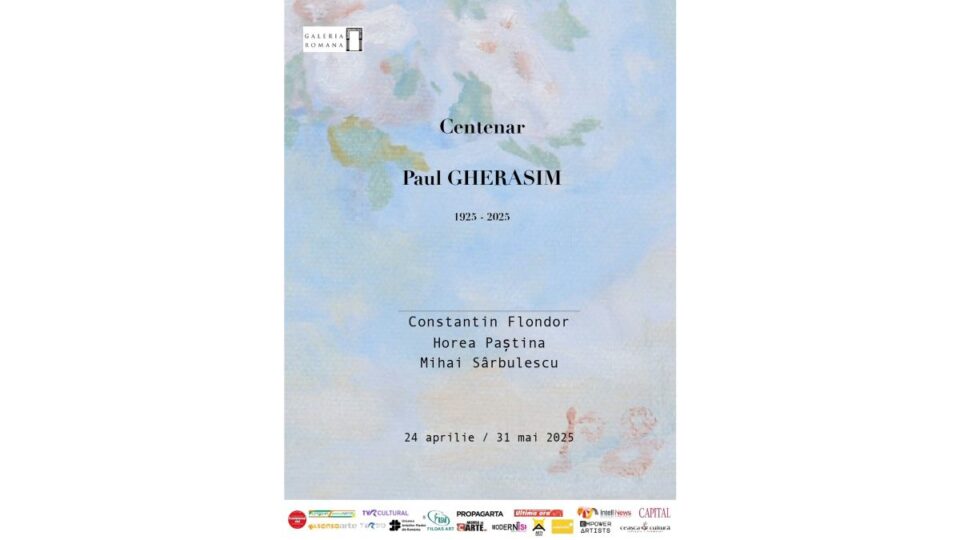
At the same time, this year, Galeria Romană in Bucharest organised the “Paul Gherasim Centennial (1925-2025)”, as a living testimony of a friendship beyond time for the members of the group, celebrating 40 years of activity.
The editor-in-chief of the “Dilema Veche” cultural magazine, Sever Voinescu, had this to say about Prolog:
Sever Voinescu: “The Prolog Group is a paradoxical group… It is a long-lived group, 40 years old. It’s been around and working for 40 years, but it works in its own very interesting way. Each of them is a well-defined personality. They are very different from each other. It was Paul Gherasim’s extraordinary intuition to offer them this formula 40 years ago: let’s all go to the garden to paint. They took their easels, went out into the open, in plein-air and started working. And each one worked according to their own personality, according to their own style, according to their own soul. Very different things came out and yet in a way, they all talk about the same thing ultimately, and because of that I think that what holds them together is not a programme, not a goal, it’s not, how should I say, this joy of solidarity that makes each one of them feel stronger. Not in the least. It’s about the spirit. What holds them together is the Spirit.”
Paul Gherasim was a deeply spiritual Romanian painter, known for the refined simplicity of his works and for his founding role in the Prolog Group. Another founding member, the artist Constantin Flondor, spoke to us about the painter Paul Gherasim and the members of Prolog:
Constantin Flondor: “The merits of Paul Gherasim are not entirely known, precisely because he was a modest, reserved man, who never went on the offensive, but this is also part of why he was our friend and our closest advisor. He was also the oldest among us. It is interesting that Prolog members are about ten years apart: first was Paul Gherasim, who would have been 100 years old now. I am ten years younger, I’ll be 90 next year. Paștina follows ten years later, Mihai Sârbulescu and Paraschiv and so on. Interestingly, it turns out that between these generations, spanning 40, almost 50 years, there are differences, a very strong communion and a very close relationship. But of course Paul Gherasim was the impetus for our meeting in Tescani, around 1985.”
Today, at the height of the digital age, in which image is threatened to become expendable and superficial, the message of the Prolog Group remains more up to date than ever: art is, above all, a form of presence. A form of truly being. (AMP)