“Milk Teeth”, a highlight of recent Romanian cinema
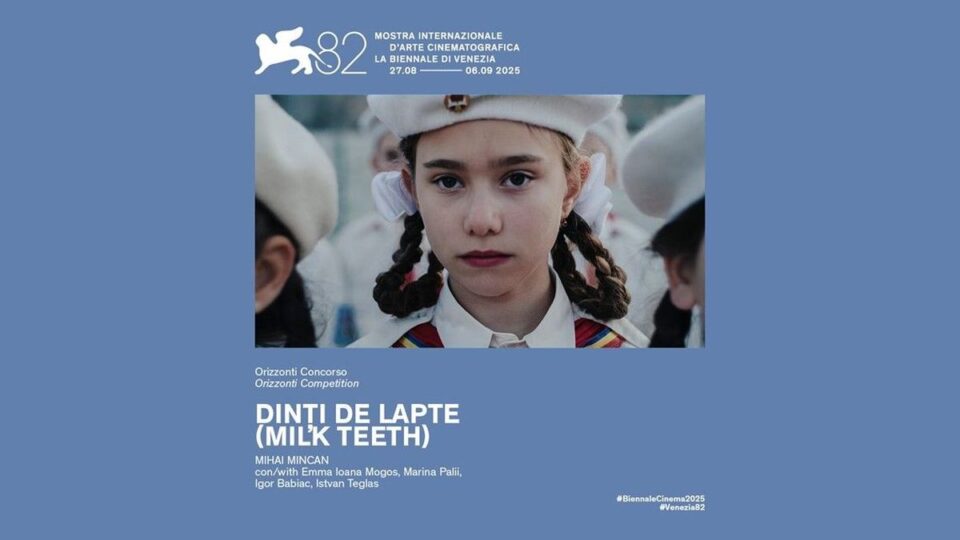
Last year, Mihai Mincan launched "Milk Teeth", one of the most powerful films of 2025.
Corina Sabău, 17.01.2026, 14:01
In 2022, Mihai Mincan debuted with the film “To the North”, inspired by a real case – migrants hidden on a cargo ship – which the director transforms into a reflection with ethical stakes, rather than a social commentary, proposing a more abstract cinema, which breaks away from the latest Romanian film pattern, anchored into everyday life. Last year, Mihai Mincan returned with “Milk Teeth”, one of the most powerful films of 2025, which challenges its viewer and refuses to fit into a specific genre, although it borrows elements of horror movie, thriller and family drama.
“Milk Teeth”, which premiered in the Orizzonti competition section at the Venice International Film Festival, is set in a declining mining town in 1989 and begins with the sudden disappearance of a little girl. The case is taken up by a policeman (played by István Téglás) constrained by the limits of the system. The parents (played by Marina Palii and Igor Babiac) are paralyzed by fear and guilt, and the tension of waiting and the lack of answers gradually cracks the family’s balance.
Told from the perspective of the missing girl’s sister, Maria (played by Emma Ioana Mogoș), the film avoids a direct criticism of communism and focuses on the world seen through the eyes of a child. The story is built from unsaid or misunderstood things, from fragmentary discussions with other children, often indifferent to the girl’s disappearance, mixed with music – like Pet Shop Boys and Hot Butter -, sounds and images of the 1980s, and is crossed by an anemic, melancholic light, which disappears in places altogether, leaving room for darkness.
I talked to Mihai Mincan about the perspective chosen in the film, influenced by his childhood memories and personal experiences related to his daughter, but also by the atmosphere full of uncertainty and oppression of the 1989: “One of the reasons why I chose the perspective of Maria, the missing girl’s sister, is largely autobiographical. My relationship with my daughter mattered a lot. When she was little, she had a rougher entry into the world, she spoke late and spent a lot of time looking out the window, at the trees, she seemed to have a rich inner world, which she did not externalize. She also went through episodes of night terrors, that is, a kind of nightmares. I remembered that I also had such fears, related to the darkness, to the shapes that seemed to come out of there. So I felt that I could write from this area, of the inner world of a child. In addition, the film talks about loneliness and confusion, and the child’s perspective seemed to me the most honest and suitable to convey these feelings, compared to that of an adult, who has more information and is connected to the world differently. And, it is true, the fact that, at the time of the 1989 Revolution, I was 9 years old, also played a very important role. I felt that I could understand the world in which the disappearance of the little girl was taking place. It was an emptied world, almost sucked out of any form of vital energy, a world from which I can very well remember sounds, colors and textures. It is a world that is still close to me.”
In the film, István Téglás plays the communist policeman who investigates the disappearance of Alina Lucaciu. The actor confessed that he was initially afraid of this role, because of the associated clichés, but the script revealed a more human and empathetic side of the character, a nuanced character, caught between the limits of the institution he represents and the ability to recognize the suffering of the family. Mihai Mincan told me about his collaboration with István Téglás and how they built together a character who is unlike the classic type: “I talked a lot about this with István and it was the main reason why he accepted the role. Our first discussion about the film, when I told him that I wanted to collaborate, started from here: I told him that I wanted to build a policeman who was not the type seen in most Romanian films. I had collaborated with István before, I know what he is like, I know what he can do, I know what he offers me. He is an extremely generous man in a broad sense and I also see him as a good friend, we don’t talk every day, but every time we meet there is a mutual understanding and acceptance. The character he plays is, in turn, overwhelmed by the world he lives in and the system in which he operates. But, even though he lives in this cold and gray world, he retains a very clear trace of empathy towards the drama that the family of the missing girl is going through. Because I refuse to believe that all the policemen from that period, from communism, were brutes. I refuse to believe that a man, especially one who had children, would have been incapable of relating to or understanding the drama of a family that loses a child. Such a character, built only as a brute, would have been false to what I believe people were, in fact, at that time.”
The director of photography of the film “Baby Teeth” is George Chiper-Lillemark, and the editing was done by Dragoș Apetri. Marius Leftărache and Nicolas Becker composed the music, and Cyril Holtz did the sound mixing. The set design is signed by Anamaria Țecu, and the creation of the costumes was coordinated by Dana Păpăruz. (EE)