Brâncuși 150
2026 marks the 150th anniversary of the birth, on February 19 of the great Romanian sculptor Constantin Brâncuși.
Leyla Cheamil, 19.02.2026, 13:50
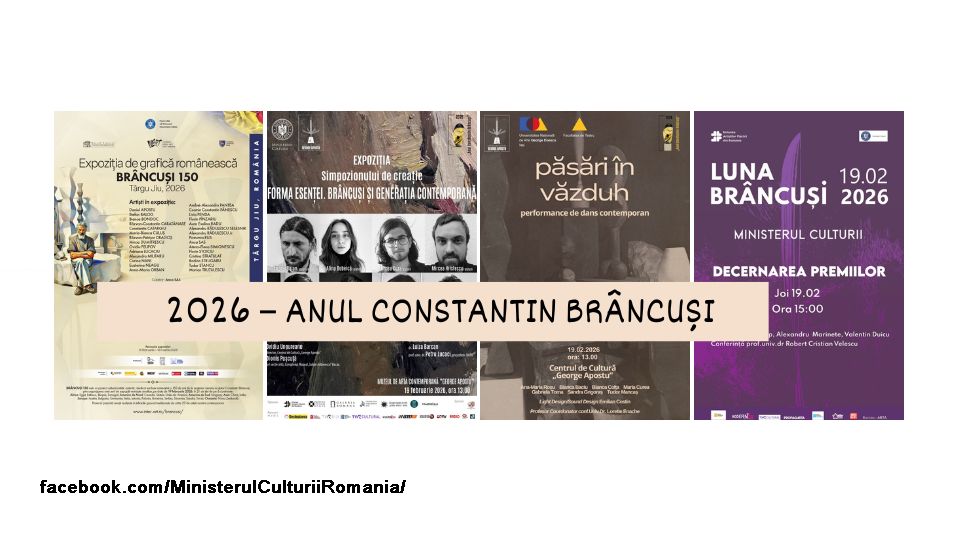
In Romania, 2026 has been declared the “The Constantin Brâncuși Year”, marking 150 years since the birth of a sculptor who made a decisive contribution to the renewal of the artistic vision in modern sculpture. The initiators of this initiative said that the establishment of the Brâncuși Year is “an homage paid to an emblematic personality of universal Romanian culture”. Also, the Constantin Brâncuși National Day is marked on February 19, the sculptor’s birthday, having been officially established by law in 2015.
A posthumous member of the Romanian Academy, Constantin Brâncuși was born in the village of Hobița, in Gorj County (south). Since childhood, he was attracted to traditional crafts and especially woodworking, and this connection with Romanian tradition left its mark on of his entire artistic work. He attended the School of Arts and Crafts in Craiova and graduated from the National School of Fine Arts in Bucharest, where he began to discover his own style. The desire for perfection led him to go to Paris, the artistic center of Europe in the last century, where he came into contact with avant-garde and cubism. In 1905 he was admitted to the prestigious École Nationale Supérieure des Beaux-Arts. In fact, he lived most of his life in Paris, where he dedicated himself to art. He refused to work as an apprentice in Auguste Rodin’s studio, saying that “nothing grows in the shade of great trees”.
At the beginning of his career, his sculptures consisted mainly of classical representations of the human form. Over time, he eliminated unnecessary details, focusing on the spirit of the object and sought to transform raw materials, such as wood, stone, marble and bronze, into pure forms. Until 1914, he regularly participated in collective exhibitions in Paris and Bucharest, inaugurating the cycles Masterful Birds, Sleeping Muse or Miss Pogany. In 1914, Brâncuși opened his first exhibition in the United States of America, in New York, where he caused a sensation. The American collector John Quin bought several of his sculptures, ensuring him a material existence conducive to artistic creation. In the socialist realism Romania, Brâncuși was contested, being considered one of the representatives of cosmopolitan bourgeois formalism. However, in December 1956, the first personal exhibition of Brâncuși in Europe opened at the Republic s Museum of Art in Bucharest.
It was not until 1964 that Brâncuși was “rediscovered” in the country as a national genius. Consequently, the monumental ensemble from Târgu-Jiu (south) formed by the Endless Column (of Gratitude), the Table of Silence and the Gate of the Kiss could be set up. In March 1957, Constantin Brâncuși passed away, being buried at the Montparnasse Cemetery in Paris. On the occasion of the Constantin Brâncuși Day and the Constantin Brâncuși Year, a multitude of events organized in the country and abroad are dedicated to him. Exhibitions, conferences, multimedia events, concerts and theater performances, all pay tribute to the creative genius of the Romanian sculptor. (EE)