The Romanian prime minister travels to Brussels
Romanian Prime Minister Ilie Bolojan travelled to Brussels on Thursday to convince the European Commission that Romania has achieved the milestones set out in its National Recovery and Resilience Plan and should receive the funds provided for in the programme.
Sorin Iordan, 27.02.2026, 14:00
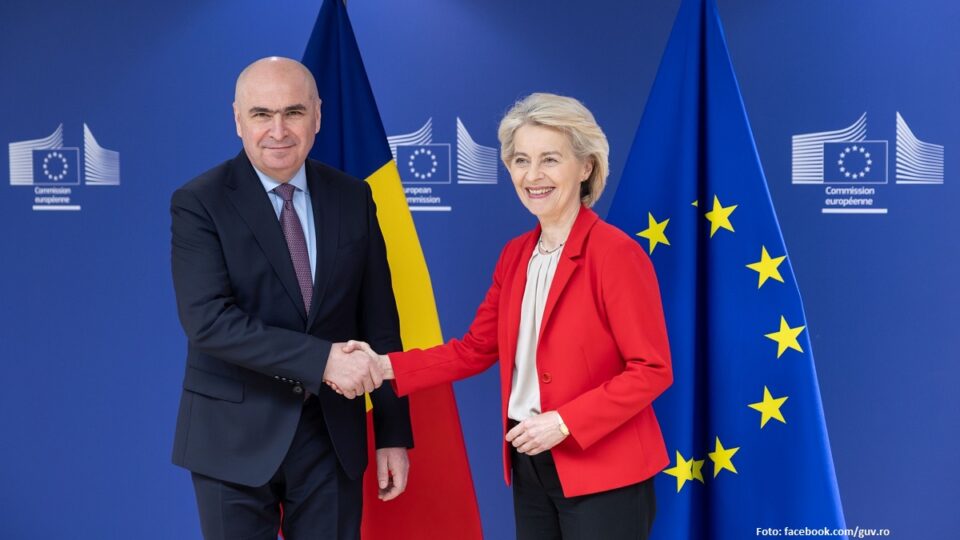
Romania does have a chance of receiving some of the remaining payment for the 3rd tranche of its National Recovery and Resilience Plan, said Prime Minister Ilie Bolojan. During a trip to Brussels, he tried to convince European decision-makers that Romania has fulfilled its commitments and should receive the 231 million euros conditional on the implementation of the magistrates’ pensions reform. The Prime Minister met, among others, the president of the European Commission, Ursula von der Leyen, and the Commissioner for economy, Valdis Dombrovskis, telling them that his government did fulfil its task in time, but that the reform was blocked in court. Romania’s president Nicuşor Dan did in fact signed into law the bill on the reform of magistrates’ pensions, after the Constitutional Court the previous day published in the Official Gazette the reasons for its ruling that the bill complies with the Constitution.
The reform of magistrates’ pensions is a milestone in the National Recovery and Resilience Plan and due to the delay in its implementation, Romania only received 1.3 billion out of the approximately 2.2 billion euros it was entitled to under the 3rd payment. Ilie Bolojan:
“As for the funding pertaining to this milestone, from the discussion I had with the Commission president, I am optimistic, but there are some aspects that depend on how you look at them. However I believe that this great effort made to put into practice our commitment as a country, to correct an injustice, entitled us to hope that the European Commission, noting what has been done, will seek to adopt the best solution that it can put into practice for Romania.”
Romania is also awaiting the payment of the 4th tranche under the National Recovery and Resilience Plan, worth approximately 2.6 billion euros. The European Commission is assessing the stage of implementation of the reforms, the deadline being the end of August. One of the milestones, however, is decarbonisation, a problematic aspect for Romania, given that eliminating coal from energy production is a long-term process.
The discussions in Brussels also focused on the European SAFE defence program and Romania’s budget deficit. European officials praised Bucharest’s compliance with its obligations, the decrease of its budget deficit to 6% of GDP this year, and the pace of development of defence investment plans. Defence was, in fact, a key point of the visit. The Romanian Prime Minister attended the launch of the EastInvest financing platform, a financial mechanism worth around 28 billion euros dedicated exclusively to investments in European states bordering Ukraine, including Romania. The funds can be attracted by both authorities and private companies. However, the programme operates on a “first come, first served” basis, so Romania must hurry up and propose viable projects to attract as much funding as possible.