Village Museums (Reposted from 12.03.2026)
In contrast to museum institutions in large cities, which enjoy organic visibility and a constant flow of tourists, small exhibitions, ethnographic collections and memorial houses in the village risk remaining in the shadows.
Daniel Onea, 27.08.2026, 14:00
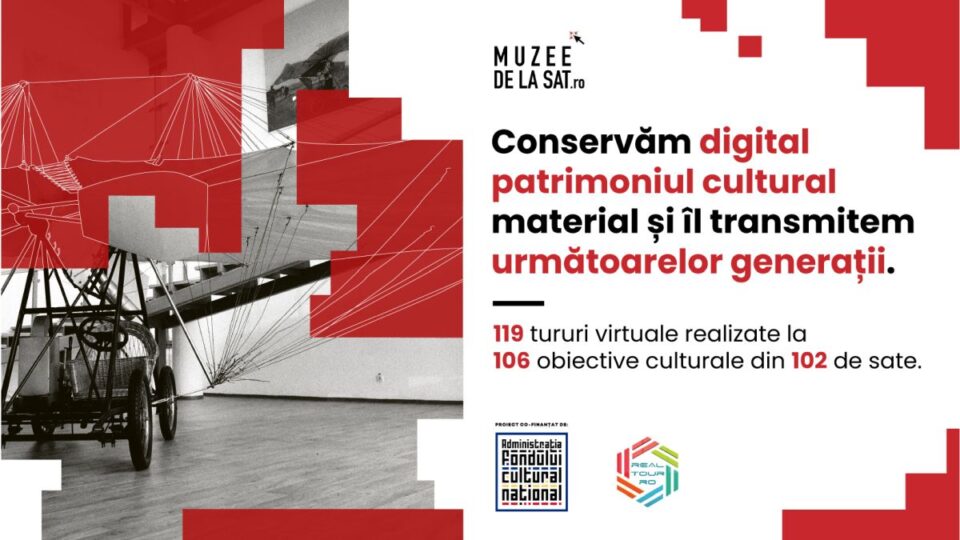
Romania hides genuine cultural treasures in its rural areas, which often remain unknown due to the lack of marketing resources. In contrast to museum institutions in large cities, which enjoy organic visibility and a constant flow of tourists, small exhibitions, ethnographic collections and memorial houses in the village risk remaining in the shadows. To balance this situation and bring rural heritage into the digital age, an initiative combining tourism and technology was born.
Cosmin Murărașu, the manager of the “Village Museums” project, explains the steps taken so far to document these objectives: “The project began in 2021 and, gradually, every year, we have traveled to different regions of the country. We started with Moldavia, followed by Wallachia known as Muntenia, Dobrogea, Maramureș, Oltenia and Banat, and our intention, in the near future, is to expand the initiative to the entire country. We travel to rural museums, where we make 3D laser scans, photographs, interviews and presentation videos with museographers. We process these materials and publish them on our social networks, on the muzeedelasat.ro website and in our application, available for Android and iOS. At the same time, we offer them free of charge to the beneficiary museums, to support them in their promotional efforts.”
Access to these digitized archives was designed to be as intuitive as possible. The initiators have developed an IT ecosystem designed to facilitate not only remote exploration, but also the logistical planning of an actual trip for tourists in transit. Cosmin Murărașu details the usefulness of these tools: “On the platform, we offer absolutely all the details necessary to physically reach the desired location: contact numbers, email addresses, opening hours and prices. In addition, the free application «Village Museums» includes a useful function that generates the optimal route. By simply pressing the navigation button to a specific museum, the route is automatically created in Google Maps, guiding the user directly to the destination. Also, based on the visitor’s location, the application indicates the nearest objective, thus encouraging their physical visit. Both in the application and on the web platform, users can access the interactive 3D virtual tour, designed to capture their interest and show them the richness of the exhibits.”
Beyond visual innovation, the essence of these rural cultural spaces is represented by the human factor. Unlike the hustle and bustle of large urban galleries, the tranquility of the village offers the visitor a higher-quality experience, based on authentic dialogue. The project manager emphasizes the inestimable value of this direct interaction. Moreover, these institutions are not simple warehouses for storing old objects, but a living heritage, often animated through workshops and events dedicated to the community or children. Each documented destination hides a distinct story, capable of transforming a simple stop on the route into a profound memory.
Cosmin Murărașu recalls some of his discoveries in the field: “We had extraordinary experiences in each institution we visited, because each one has a unique particularity. A memorable memory is from 2021, from the Tescani section of the “George Enescu” National Museum. While we were scanning and digitizing, the works of the great composer could be heard in the background, creating a fascinating atmosphere that completely absorbed us into that space. Another special experience was in Maramureș. There, in traditional houses, we met museographers and locals who dedicate their lives to preserving the heritage. They manage to perfectly convey the spirit of the place, telling the stories learned from their grandparents and recreating a deep sense of familiarity, of “home”. Another excellent example is the “Nicolae Bălcescu” Museum in Vâlcea County, where the team does a remarkable job in promoting and diversifying the public by organizing educational activities for children. Indeed, each museum has its unmistakable charm.”
The effort to present these places at high technical standards has crossed national borders. The quality images and impeccable virtual tours function as a calling card of rural Romania, attracting the attention of foreign tourists in search of unexplored destinations. Our interlocutor explains the impact that technology has on the travel decisions of the international public: “Our platform and application are accessible globally, and our efforts are also actively directed towards international promotion. It is very interesting that the second largest community of visitors to the “Village Museums” platform comes from the United States, which proves our extensive impact and makes us very happy. We also receive numerous calls from people interested in organizing physical excursions. We have often been contacted from abroad by tourists who searched for certain areas on Google and discovered our platform; impressed by the quality of the materials, they immediately decided to include these museums on their vacation list. Naturally, when we plan a trip to a new region, we search the Internet for the most attractive landmarks to build a route. If those locations do not have high-quality promotional materials, they lose the chance to attract tourists. This is the main reason why our project places a special emphasis on creating high-fidelity 3D virtual tours, complemented by professional photos and videos. The quality of the materials is essential to convince the public, including those outside the country.”
The digital exploration offered by the project is an excellent promotional tool and is also possible thanks to co-financing from the Administration of the National Cultural Fund. But the true support of national culture is achieved on site. No virtual experience can replace the smell of a traditional house, the texture of old objects or the direct dialogue with the people who keep the identity of the Romanian village alive. (LS)