Bright Future – the Archive of a Collective History
The documentary “Bright Future” had an important festival run
Corina Sabău, 28.03.2026, 13:08
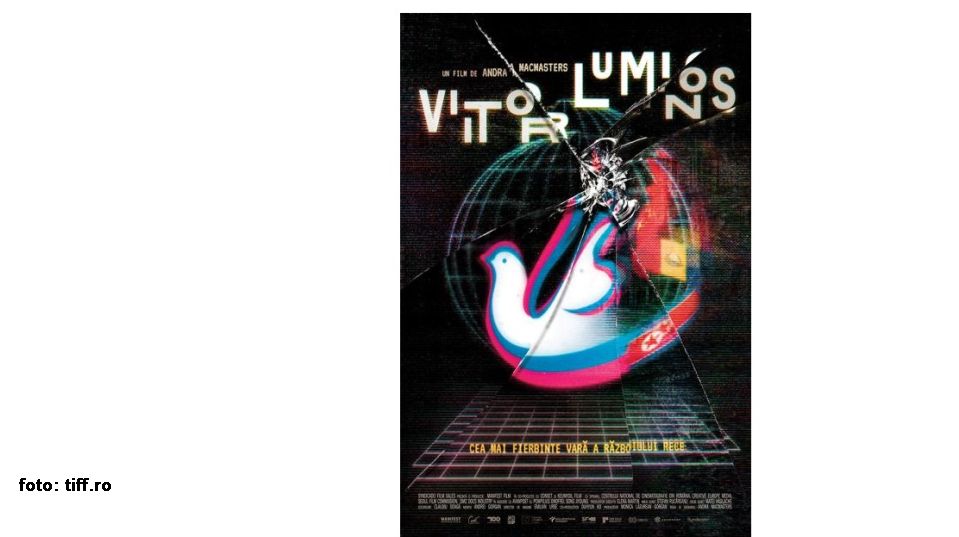
Following its world premiere at the Amsterdam International Film Festival (IDFA), the documentary “Bright Future”, directed by Andra MacMasters and produced by Monica Lăzurean-Gorgan, had an important festival run. In Romania, the film was included in the official selection of festivals such as TIFF / Transylvania International Film Festival and the Râșnov Historical Film Festival, and won the award for best director in the Romanian section at the Astra Film Festival.
The documentary “Bright Future” is a Romania – South Korea co-production that focuses on a tense moment in recent history, set in the summer of 1989 against the backdrop of the Cold War. At that time, for the first and only time in the country’s history, North Korea opened its borders to welcome over 20,000 young people from 177 countries, as part of the 13th edition of the World Festival of Youth and Students. Over 600 round tables, cultural and sports events were organized; but the event was mainly political in nature, targeting issues such as peace, nuclear disarmament, the fight against imperialism, the environmental crisis, and the rights of youth and women. The Romanian delegation, consisting of 180 young students, as well as personalities from the political and cultural communities at the time, traveled to Pyongyang. Romania had a privileged position due to the special friendship between the two countries.
But the festival took place in a tense international context: three weeks earlier, the Chinese government had violently suppressed the student protests in Tiananmen Square, and the first cracks were appearing behind the Iron Curtain.
‘Bright Future’ features well-known arts personalities, such as Silvia Dumitrescu, Loredana Groza, Daniel Iordăchioaie, Dan Bittman, Claudiu Bleonț and Vasile Muraru, as well as future politicians or businessmen, some of whom later became public figures: Adrian Năstase, Mugur Isărescu, Elena Ciocan, and Dan Puric.
The images that make up the montage documentary “Bright Future” belong to the archive of Emilian Urse, an amateur filmmaker who was mandated by the then Minister of Youth, Ioan Toma, to travel to Pyongyang to film the event.
Andra MacMasters: “In 2017, as part of a larger project carried out together with Emilian Urse, I worked on the digitization of the ‘Stud-Film’ archive in Bucharest – the first student film club in Romania. The project culminated in the launch of the cineama.ro platform, where films made by students between 1957 and 1989 can be watched. During the preparations, Emilian Urse gave me several 16 mm film reels with the students’ works. I digitized them and included them on the platform. At the same time, Emilian also handed me a few video cassettes. In the late 1980s, he owned a Panasonic VHS camera – quite a rare thing in Romania at that time. Thanks to it, he had managed to film moments from both before 1989 and the 1990s. I was lucky that these cassettes were kept in good condition and did not demagnetize, which made the digitization process relatively easy. With the support of the Archive National Film Institute, we managed to transfer the four tapes, each approximately three hours long, into digital format.”
One of the great qualities of the film “Bright Future” is that it does not rely solely on the strength of spectacular images, viewed today from the distance of over three decades. The film places these images in a broader context and captures the pulse of international events – from Nicaragua and Chile, to the Baltic countries, Hungary, China, and the Soviet bloc, which was beginning to falter.
Andra MacMasters: “Yes, that’s right. It’s a thesis that I formulated quite timidly at the end of the film – that the politicians who came to power immediately after ’89 would have had more information than us, ordinary citizens. The festival took place in the summer, and Emilian Urse told me that there were already discussions back then, for example, about the protests that were to take place in Prague in November. The film is also the result of extensive research in international archives – the European Archives in Florence, the UNESCO Archives in Paris, I even went to Seoul, to the Archives of the Department of North Korean Studies, where I consulted the North Korean press. From all these fragments I built a dialogue with the images filmed at the time. I tried to capture this global pulse, but without privileging a single perspective – neither Western, nor Socialist, nor non-aligned countries. The stakes of this festival were actually to attract non-aligned countries to one side or the other. And the Romanian delegation, seen in this context, it seems almost detached from reality. Unfortunately, I was not able to find the complete list of participants in the archives either.”
This is how the Astra Festival jury motivated its decision to award the film “Bright Future” the Best Direction Award in the Romania competition section:
“The director finds empathetic ways to reinterpret the past, to challenge us to look at the present differently, remembering our youth as a force of resistance. The jury appreciates the film’s laborious and original process of highlighting forgotten historical images, celebrating the vision of an overlooked filmmaker. Through a poetic collage and polyphony, the director transforms memory into dialogue.” (CC, AMP)