“Journey to the afterlife” – an exhibition
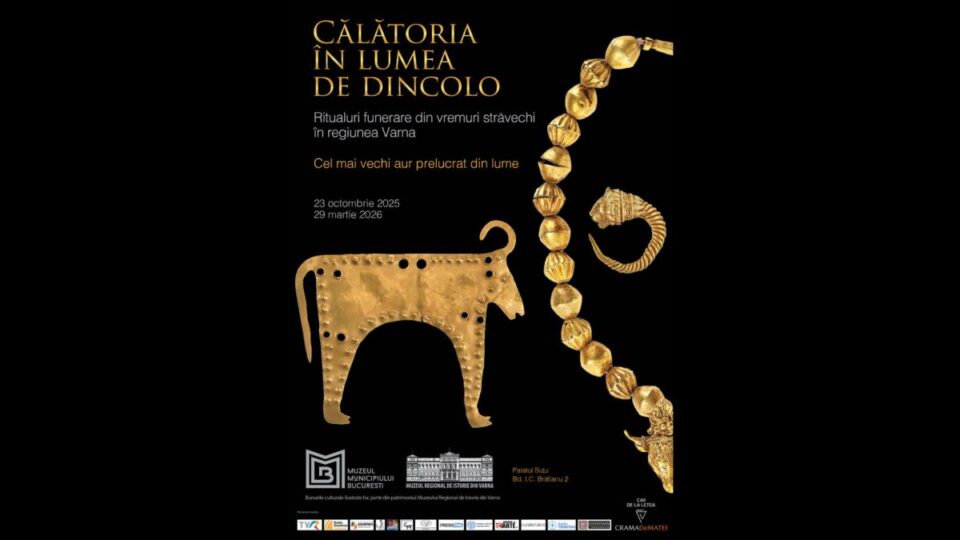
The Bucharest City Museum is playing host to a temporary exhibition entitled “Journey to the afterlife. Ancient funerary rituals in the Varna region”.
Ion Puican, 28.02.2026, 14:00
The Bucharest City Museum is playing host to a temporary exhibition entitled “Journey to the afterlife. Ancient funerary rituals in the Varna region”, and which can be visited until the end of March at the museum’s headquarters in the Suțu Palace in Bucharest. It is a project that brings together spectacular archaeological discoveries from the famous Eneolithic funerary complex in Varna, Bulgaria. The exhibition is a foray into the spiritual universe of prehistoric communities from the 5th millennium BC, shedding light on the rituals, beliefs and symbols associated with the passage to the afterlife. Vasile Opriș, the head of the museum’s Systematic Archaeology and History Section gives us more details about the exhibition:
“On October 23rd, the Bucharest City Museum opened an exhibition entitled Journey to the afterlife which is about funerary practices from antiquity and prehistory in the Varna region. We brought artefacts from Bulgaria to Bucharest, something that has not really been done before. As a prehistorian, I had known for some time that Varna was home to priceless artefacts. The world’s oldest remains of processed gold were discovered in the Chalcolithic necropolises in Varna. Gold is a metal that has always fascinated us. It fascinated them too, except that they were the first people in this world to discover how to process it. The exhibition, as I was saying, is focused on funerary practices and their evolution in this area. Varna is an important city in Bulgaria today, and in prehistory, the way in which civilizations succeeded each other here points to a very dynamic area. And from the perspective of funerary practices, they are very different from one period to another and the exhibition is a concise journey through the history of funerary practices in the southeastern part of Europe using Varna as a point of reference.”
Visitors can discover valuable gold artefacts considered among the oldest processed gold objects in the world. Ornaments, tiaras, necklaces, beads and funerary applications reveal not only the technical mastery of those communities, but also the existence of well-defined social hierarchies. The amount of gold deposited in certain tombs suggests the emergence of elites and outlines the image of a surprisingly complex society for the Eneolithic era, in which gold had both symbolic and spiritual value, as well as a role as a marker of social status. The exhibition also features ceramic and religious objects that reflect the social status, hierarchies and the views of life and death of those communities. The exhibition is not merely about funerary practices, but about a sophisticated civilisation, with a remarkable material and spiritual culture for its era.
Vasile Opriș also told us how the exhibition “Journey to the afterlife” ended up travelling to Bucharest:
“The collection is comprised of thousands of gold objects, which were discovered in these necropolises. Some graves contain thousands of objects. The abundance is unprecedented. The Varna collection very rarely leaves the Varna museum and when it does, it usually travels to Tokyo, Paris, New York or some other big European capital, to cities and museums with great reputation around the world. That was also one of the reasons we had to bring it to Bucharest, because in my view it would have been a pity not to, considering that we are still quite close. We started negotiations with our colleagues there in 2022. They were more reluctant at first. In 2024, we took an exhibition from Bucharest to Varna, about the Bulgarian resistance in the modern period and which was very visible in Bucharest. Apparently, we impressed them enough and the following year they were willing to bring us this exhibition that conceptually belongs to them, it is curated by our colleagues from the museum in Varna. We just staged it here, together with them. And I think it is worth visiting, something you might only see once in a lifetime”
“Journey to the afterlife” is, in essence, an invitation to reflect on how people have understood the mystery of death and continuity. Through these testimonies dating back over six millennia, visitors have the opportunity to look back in time and discover the roots of beliefs that, in one form or another, are still with us today.