Tasty treats and twinkling lights
Euranet Plus Panorama is a weekly news review that showcases our network’s wide-ranging coverage of EU-related stories.
Adaugă ca sursă preferată în Google
Radio România Internațional, 22.12.2025, 20:38
Tasty treats and twinkling lights
As the year draws to a close, we take a little European tour to find out more about some of the festive traditions being played out across the bloc over the coming weeks.
Christmas has long been more than a purely Christian festival, being widely celebrated nowadays – in Europe and beyond – by people with no religious affiliation at all. But most of us know, and even follow, traditions that are rooted in the Catholic and/or Protestant churches.
Carolling capers
Romania, though, is home to millions of Orthodox Christians.
In much of the country, therefore, Christmas is celebrated on 7 January and New Year a week later. In terms of customs, there are many similarities with the December-based traditions marked by other Christian faiths, as Paul Condrat, a member of Romania’s Lipovan Russian community, tells Radio România.
Paul Condrat, Orthodox Christian (in Romanian):
“[Our] holidays are a little different, with Christmas and New Year’s Eve being celebrated mainly with family, in small, intimate gatherings. Our Christmas Eve is a quiet evening, without any parties. On Christmas Eve, older children and young adults go carolling. Then on New Year’s Day, the first day of the year, the carolling is done by the youngest children.”
And what do they eat?
Paul Condrat, Orthodox Christian (in Romanian):
“Traditional local seafood cuisine and, of course, during the winter holidays, even old-fashioned cuisine. Local guesthouses also offer traditional pork dishes, stuffed cabbage rolls, cold cuts, and Russian-style pork dishes. Otherwise, among the traditional fish dishes, fish borscht is definitely the star – it cannot be missing from any meal. And then there are other fish-based snacks, smoked fish, caviar, various types of marinated fish, fish balls…”
All about the food
On the important subject of food, Nantia Liargkova heads up SKAI Radio’s gastronomy website. She gives us a tour of some of Greece’s culinary Christmas traditions.
Nantia Liargkova, Director of cookout.gr (in Greek):
“In Naxos, for example, housewives knead [traditional Christmas bread] with raisins and walnuts, which they share with all the people and animals in the household. In Syros, shipowners decorate a small boat symbolising the new life that Christ brought to the world, and children go around singing Epiphany carols and carrying lanterns made from oranges. In Mykonos, during the days leading up to Christmas, the central tradition is pig slaughtering, from which pork fat and local sausages are produced. Pig slaughtering customs exist all over Greece, including Arcadia and Thrace, where the festivities generally begin 40 days earlier. […] In Arcadia, they cook pork with apples and quinces on Christmas Eve, meat pie with beef or lamb, and cured meats and [fried cubes of pork skin], while in Laconia, they prefer pork with celery.”
Our colleagues at esRadio have an extended interview with Almudena Villegas, a Spanish writer, researcher, food historian and member of Spain’s Royal Academy of Gastronomy.
She talks a lot about festive traditions, both past and present, including the famous Three Kings celebration.
Almudena Villegas, Member of Spain’s Royal Academy of Gastronomy (in Spanish):
“The Three Kings’ Cake is also a very old tradition, one that is also celebrated in France – so it’s not exclusively Spanish. The Three Kings’ Cake, which contains a so-called ‘bean’ and a small gift. This cake was even eaten by the Romans during the Saturnalia celebrations. Back then, there was a nice gift inside the cake, and also a bean. The person who received the bean would become a slave for a day. In other words, it was like a punishment. Today, we are not enslaved to anyone, of course. But that’s what it meant for people back then. […] It all begins with the excitement of Christmas Eve and ends with a day almost entirely dedicated to children, with the Three Kings’ parades – something that is so very Spanish and really sets us apart from the rest of Europe.”
And sticking with culinary traditions, families in the small fishing town of Póvoa de Varzim in northern Portugal still eat their Christmas Eve dinner on the floor, as many generations of fishing families have done before them.
The custom stemmed from the importance of family unity and the limited capacity of fishermen’s homes. Since the small dwellings became cramped with the arrival of family members for the Christmas celebrations, the small amount of furniture they owned was cleared out of the way and blankets spread out on the floor instead.
Historically, they would have eaten out of a big, shared bowl, with their fingers, but now they allow themselves the small luxuries of plates and cutlery, as local resident Júlia Ralhão tells Rádio Renascença.
Júlia Ralhão, Fisherman’s Wife and Daughter (in Portuguese):
“A blanket is placed on the floor here, and we’re all set. It’s like a tablecloth. I bring the serving dishes, kneel down here, and dish the food out onto the platters. I put out potatoes, cod, cabbage and [a type of small coastal shark] that we eat dried. Then we all gather around the food. Each couple have their own platter to eat from.”
Good will to all men
Of course, a key message at this time of the year is one of solidarity and good deeds, and a number of new ‘traditions’ have stemmed from a desire to make a positive difference to the lives of others.
Under the large Christmas tree on Place Kléber in Strasbourg, the aroma of button mushrooms, onions and shallots fills the air. For 13 years now, at every Christmas market, the city’s residents and tourists alike have been able to discover and savour original soups created and served by Michelin-starred chefs from the Alsace region.
Since 2013, these soup sales have generated over half a million euros for Humanis, a collective of NGOs working in the sphere of local and international solidarity. Last year’s funds were used to support initiatives providing access to drinking water and sanitation in Romania, Moldova and Bulgaria.
Humanis co-chair Raymond Sander explains to France’s euradio where the idea originally came from.
Raymond Sander, Co-Chair of Humanis (in French):
“Mulled wine is already available everywhere at Christmas markets, but there was no soup. When we started with the soup, it was something new. The first year, we sold 3,000 litres, and now we are selling 17,000 litres of soup a year. To make it work, we had to come up with something out of the ordinary. So we turned to Michelin-starred chefs. More than 29 Michelin-starred chefs have already had a hand in these Michelin-starred soups. And every week, another great chef comes in.”
The initiative certainly gets a thumbs-up from passers-by.
Passer-by (in French):
“Absolutely delicious. It’s great to be able to try something you would never have tasted anywhere else, because you don’t get to go to a gastro restaurant every day.”
New takes on the nativity
Priscos, in the north of Portugal, is home to an annual nativity tradition that is said to be the largest ‘live’ nativity scene in Europe. By live, we mean that it is a huge immersive, multi-sensory experience recreating life in the ancient Holy Land.
And each year, there is a special cause that the event is held in aid of. This year, the aim is to draw attention to disability issues, as Father João Torres from the Archdiocese of Braga tells Renascença.
João Torres, Priest (in Portuguese):
“Young people with disabilities lack opportunities for social and professional inclusion. There are a shortage of places in training and after-school support centres, a lack of homes for young people and adults with disabilities, and a lack of therapeutic support and adequate resources.”
The initiative also supports the inclusion of another socially disadvantaged group, Father Torres goes on. Namely, ex-offenders. Indeed, a number of prisoners helped to construct this year’s nativity scene, thereby beginning their process of re-entry into society.
João Torres, Priest (in Portuguese):
“We want this nativity scene to have more and more inmates who can dream of their social reintegration here, where they can return to society better than when they entered prison.”
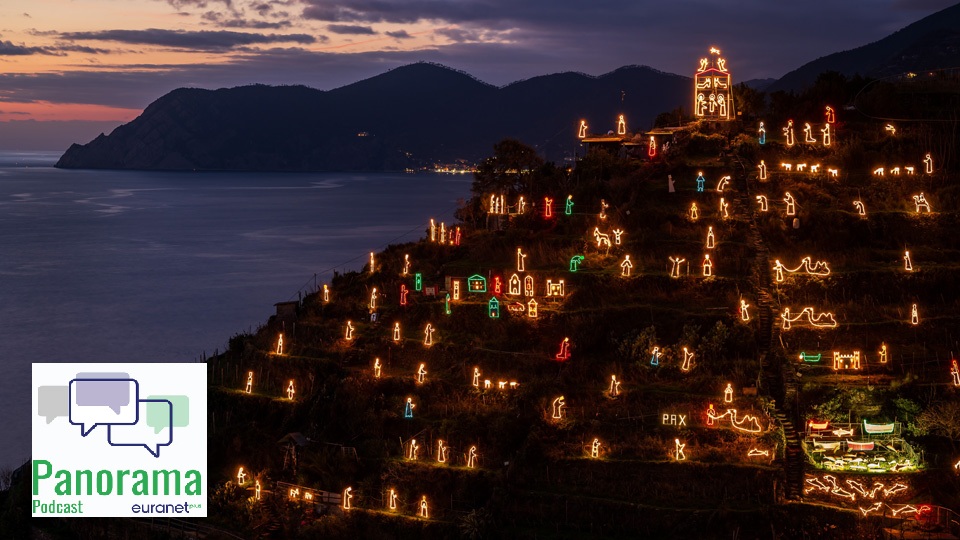
Another place vying for a podium spot when it comes to the largest nativity scenes is Manarola, one of Italy’s beautiful Cinque Terre villages. Manarola stages the largest ‘illuminated’ nativity scene in the world.
This festival of lights, which began on a much smaller scale more than 60 years ago, is as unique as the Cinque Terre region itself. In it, the hillside surrounding the village is lit up with over 17,000 lights and hundreds of large figures for the whole of the festive season.
Lorenzo Viviani, president of the Cinque Terre National Park, tells our partners at Radio 24 more about this magical nativity spectacle, which is now run annually by a not-for-profit.
Lorenzo Viviani, President of the Cinque Terre National Park (in Italian):
“Mario Andreoli’s nativity scene covers the terraced hillside of Manarola, which is already a picture postcard, making it even more beautiful. Its illumination is a local tradition. It is linked to a promise its creator, Mario Andreoli – who sadly passed away a few years ago – had made to his father: a promise to light up some crosses on the hill. Figures were then added, almost 250 animated figures, which bring this nativity scene to life, attracting many visitors to the Cinque Terre area in December and during the Christmas period. […] It is also a concept of reuse that, from an environmental point of view, is a wonderful thing to promote because no new materials are used. Instead, items discarded by the community are given a second life by being used to create small works of art.”
Catchy Christmas tunes
Let’s end this festive podcast on a more traditionally festive note, by inviting the creator of The Europeans’ jingle, Jim Barne, to give his thoughts on what makes a good Christmas song.
Barne also writes the music for stage shows, and one of his shows has just opened on Broadway after a run in London’s West End. It is called Two Strangers (Carry a Cake Across New York), and it’s set at Christmas time. This makes him the perfect person to ask: what makes Christmas music Christmassy?
Barne replies that when contemporary artists make Christmas numbers, they tend to incorporate a lot of things that wouldn’t typically be there in their normal pop sound. Things that give Christmas music a kind of nostalgic edge. So, what sort of things is he referring to?
Jim Barne, Composer (in English):
“The closest we can get to an answer is probably orchestration, which is like various instruments that crop up a lot. Most notably sleigh bells, choirs of angels or harps or, you know, like glockenspiels, like bells.”
The Europeans go on to ask him if he thinks it’s a bad thing that we hear so many recycled Christmas tunes, year after year, or if he considers this repetition part of the magic of the season.
Jim Barne, Composer (in English):
“I think that what’s really lovely about that is that you get this intergenerational sharing of Christmas music that you actually don’t really get elsewhere anymore. It’s kind of one of the last vestiges of lots and lots of different people from lots of different places and lots of different generations, who all know the same cultural touch points and stuff.”
Another way in which Christmas brings people together, then…
So, we will end this podcast – and this calendar year – with a short clip from a song called ‘Under the Mistletoe’ from Barnes’ musical – a song that parodies some of the Christmas classics.
Season’s greetings from all of us here at Euranet Plus. We’ll be back on 9 January… so, see you in 2026!