Panorama 04.04.2025
Euranet Plus Panorama is a weekly news review that showcases our network’s wide-ranging coverage of EU-related stories.
Adaugă ca sursă preferată în Google
Radio România Internațional, 07.04.2025, 17:51
Liberation Day: not just another Hollywood action movie
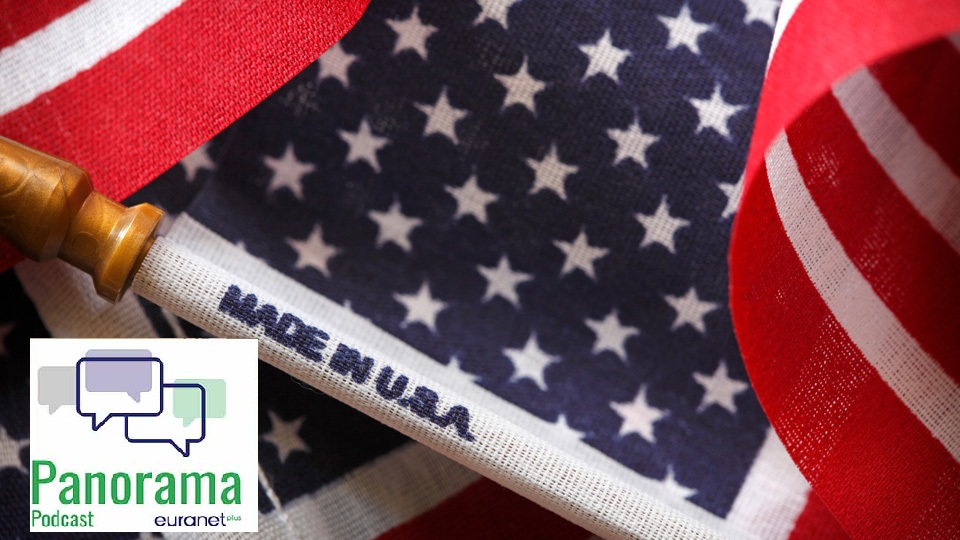
EU-US relations are at something of an all-time low right now, as Trump celebrates his first 10 weeks back in the Oval Office by pressing the red trade button.
The transatlantic relationship is a key artery of the world economy, or so says the European Council, with trade in goods and services between these two longstanding partners reaching 1.6 trillion euros in 2023 – more than the entire GDP of Spain.
A shot in the foot
These figures are backed up by 2024 data from the US Census Bureau, which confirms that the EU is the largest market for US goods exports and also the main origin of imports – coming in above Canada and Mexico in both cases.
Yet this did not prevent Washington announcing, on Wednesday night (2 April), a 20-per-cent tariff on goods imported from the EU. In his typically eloquent fashion, Trump added: “They rip us off… it’s so pathetic” and dubbed Wednesday “Liberation Day”.
In a conversation with German broadcaster AMS on Thursday, Luxembourg’s former foreign minister Jean Asselborn disagreed with the US president’s choice of words.
Jean Asselborn, Former Foreign Minister of Luxembourg (in German):
“I don’t think this day marked America’s ‘liberation’, but instead the inflation that will take hold there. That will take a little while, but this is bad for the US, it’s bad for the world, and it’s bad for global trade. As a consequence, jobs will be lost and many things in the world will become more expensive.”
Several Asian countries were hit with even higher tariffs than the EU, while many other countries, including the UK, Turkey, Australia and Brazil, got away with the bare minimum: a 10-per-cent hike. But no one is happy.
And, lest we forget, these new tariffs come on top of existing tariffs, as Kevin Verbelen, an international trade expert at association of Belgian technology companies Agoria, reminds RTBF.
Kevin Verbelen, Senior International Trade Expert at Agoria (in French):
“Don’t forget that we already have tariffs on steel and aluminium. There are already tariffs on cars, and on 3 May there will also be tariffs on car parts. If we add, because it’s cumulative, another 20 per cent in this high-impact scenario, it means that some companies will be paying more than 50 per cent – even up to almost 70 per cent – in tariffs at the border.”
What can be done?
But why does Trump consider the EU one of the “worst offenders”, worthy of higher tariffs than some of our neighbours? One key reason is that Washington believes that EU rules serve as ‘non-monetary’ barriers to US trade – for example, legislation relating to the bloc’s Green Deal and consumer protection.
So BNR asks Daniel Kiryakov from the American Chamber of Commerce in Bulgaria which direction he thinks Brussels should be heading in now.
Daniel Kiryakov, American Chamber of Commerce in Bulgaria (in Bulgarian):
“Towards rethinking the European Green Deal, the Clean Industrial Plan. The rearmament plan would also greatly help the development of Europe, not just in terms of its own defence, but also in terms of innovation and dual-use technologies. These investments and this rethinking are ongoing. The European Commission and the European Parliament need to rein in regulations, because business cannot respond at the rate at which they are being rolled out. An awful lot of energy and competitiveness is being wasted. This is the great debate between the US and the European Union, regardless of which administration is in Washington.”
Yet Bernd Lange, Chair of the European Parliament’s International Trade Committee, did not mince his words in his press statement on Wednesday night. He stressed that the EU “will not change legislation that we have shaped democratically and in the interest of EU citizens”.
In an interview with BNR that took place before Trump’s latest announcement, Stanislav Bakardzhiev from the Bulgarian Association of Wine Professionals was desperately urging caution.
Stanislav Bakardzhiev, Bulgarian Association of Wine Professionals (in Bulgarian):
“I think that there should be serious talks to try to defuse the situation, because at the moment we are in a spiral where everyone is trying to threaten the other with something more scary and ordinary business is losing out. Everyone will suffer in the end.”
But now that the horse has bolted, European companies that rely on exports to the US don’t have the luxury of ‘waiting and seeing’. Many of them are already scrambling to find practical solutions, with some even talking about moving part or all of their assembly line to the US.
There’s another way of looking at this, though, says Dominique Demonté, CEO of BioPark, a vast so-called ‘ecosystem’ of life sciences companies based in Charleroi, just south of Brussels.
Dominique Demonté, CEO of BioPark (in French):
“We’re obviously keeping a very close eye on this. We’ll have to wait and see what it means in practical terms. But we’ve also decided to take a slightly different approach, which is to ask: ‘Ultimately, what opportunities are created by this position taken by the United States?’ And, in the end, there are opportunities to be found in a whole series of other countries around the world deciding that it might be worth diversifying their markets. Countries that were very focused on the US are turning more and more towards Europe. So that’s an opportunity that we want to try and seize.”
Demonté offers RTBF a concrete case to illustrate his point.
Dominique Demonté, CEO of BioPark (in French):
“For example, this morning I was in contact with representatives from Canada. Canadian companies are saying to themselves: ‘Well, finally, the European market could be an interesting one’. We have a wide range of companies here that can work with them, that can provide them with services and that can also help them get a foothold in all the European distribution networks. We can really see that. We could be a gateway for these companies who are now thinking to themselves that diversifying is probably not a bad idea given the current geopolitical context.”
Shifting sands
Of course, there’s still a chance that Trump’s new trade policy will be a flash in the pan. He has been known to do the occasional U-turn, when all’s said and done.
This is certainly the line taken by economist Aleksandras Izgorodinas at Baltic bank Citadele, who sets out the bleak economic picture facing our friends across the pond in an interview with our colleagues at Žinių Radijas.
Aleksandras Izgorodinas, Economist at Citadele Bank (in Lithuanian):
“Current leading indicators in the US are dropping like a stone, and this decline has been ongoing for several months. The risk is that sooner or later, the drop in leading indicators – that is to say falling expectations, both consumer and corporate – will start to affect the real economy. Rapid indicators of the US economy, such as passenger numbers at airports, are also fast declining, which means that the economic cycle is indeed slowing down significantly.”
Izgorodinas believes that, as a result of this economic downturn, most of these new tariffs will be lifted in the autumn.
Aleksandras Izgorodinas, Economist at Citadele Bank (in Lithuanian):
“If US stock indices continue to fall sharply, and the economy slows down, leading to rising unemployment, I believe that Donald Trump will be forced to make quite radical adjustments to his policy of tariffs and spending cuts. However, this certainly won’t happen right away. We need to wait for the next two to three months of US macro indicators, then everyone will see that things are indeed deteriorating.”
But whatever happens moving forward, why does it currently feel like the ground has shifted beneath our feet in terms of EU-US relations?
Our French partner station euRadio puts this question to Ian Lesser, who is the College of Europe’s chair of transatlantic trade and economy as well as the vice-president of the Brussels-based German Marshall Fund of the United States.
Lesser points out that this stems from the fact that the present US administration is linking trade policy and security policy more explicitly than perhaps ever before.
Ian Lesser, Vice-President at the German Marshall Fund of the United States (in English):
“So, you have, for example, Vice President Vance saying quite directly that the way American companies are treated in Brussels will have an effect on our policy towards NATO. And that’s a very unusual thing to say. Did that kind of argument go on in the background? Perhaps, yes, in the past, but it was never made quite so explicit. And now we’re actually confronting that in a very explicit way. These worlds – the world of economy, trade, commerce and the world of defence and foreign policy – have come together in a way that we really have not seen in recent decades, and it is making the whole business of transatlantic relations much, much more complicated.”
The bloc’s foreign ministers are expected to prioritise this topic on Monday (7 April), when they come together for a Trade Council in Brussels.