EU braces after Putin cements his position
Euranet Plus Panorama is a weekly news review that showcases our network’s wide-ranging coverage of EU-related stories.
Adaugă ca sursă preferată în Google
Radio România Internațional, 27.09.2026, 22:33
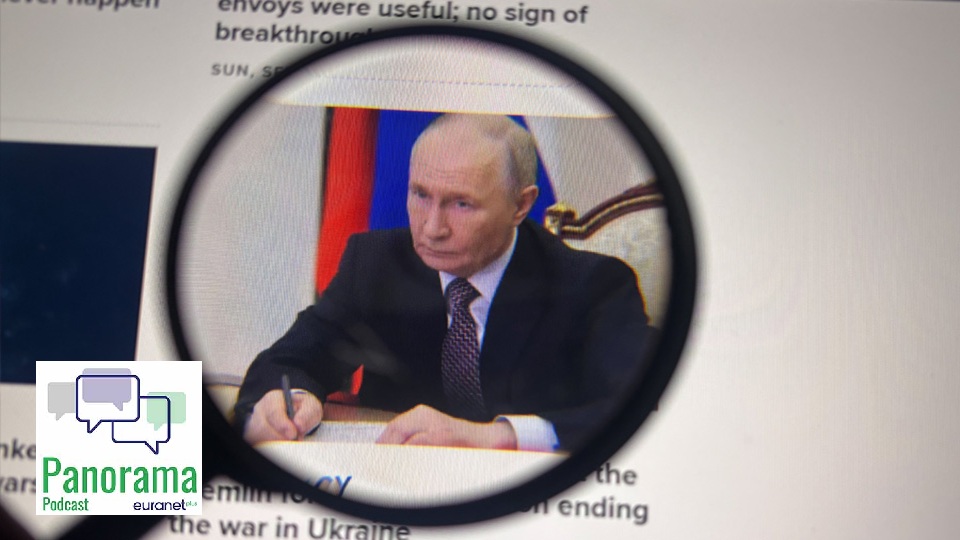
Vladimir Putin is sitting pretty in Moscow after the United Russia party secured an increased supermajority. But what will he choose to do with it?
Yes, last weekend saw the pro-Putin party win a landslide victory in the State Duma elections (18-20 September), taking a record number of seats in the lower house of the Russian parliament.
The whys and wherefores
The remaining parties that managed to pick up enough votes to make it into the new parliament were all there previously, and all back Putin’s “special military operation” in Ukraine. Indeed, the only anti-war party that had initially been allowed to take part in the election, Yabloko, was ultimately barred on a procedural pretext and removed from the ballot paper.
The lack of meaningful opposition will certainly have helped keep Putin on track in this election. But what other factors lie behind this crucial, if unsurprising, result?
According to Russian expert and ethnologist Aimar Ventsel, a senior researcher at the University of Tartu in Estonia, although there have been criticisms of the war from both economists and influencers in Russia, the Russian people simply want to keep their heads down. Ventsel is talking to Kuku Raadio.
Aimar Ventsel, Senior Researcher at the University of Tartu (in Estonian):
“Why did so many people vote for United Russia? First of all, there are many Russians that simply believe Putin is the right choice. Then there are also people who work within the Russian administrative system, which is essentially a branch of the United Russia party in most Russian regions. They have an interest in maintaining this dominance. Thirdly, there are many ways to get people to vote ‘the right way’ in Russia. It’s not always about buying votes. I know from personal experience that students are made to vote for the required candidate by forcing them to take a selfie with their ballot paper in the polling booth, showing the cross in the ‘correct’ place. In Russia, the prevailing attitude is that politics is something big and dirty. Since it’s nothing to do with us and we can’t influence anything, we’ll just do what needs to be done.”
Political commentator Valery Todorov, formerly director general of Bulgarian National Radio, tells his former colleagues that this election result likely stems from a defensive instinct on the part of the Russian people to anti-Russian sentiment abroad.
Valery Todorov, Political Commentator (in Bulgarian):
“These elections are a poll of the people, to garner public opinion, because in Russia, no matter how muted, there are anti-war sentiments. Both among the elite and among the wider Russian population, questions are being asked: how long, to what extent, at what cost? These questions aren’t going anywhere; the government cannot simply brush them aside. But in my view, the painful Russophobia that has developed in the West has created in Russians a sense of danger coming from the outside world. This reflex for self-protection is probably the main reason for the level of support that the United Russia party has received.”
Vote of confidence
Lithuania’s former ambassador to Russia Eitvydas Bajarūnas believes that President Putin will use United Russia’s victory to portray his regime as legitimate and democratic, including in his dealings with US president Donald Trump. In an interview with Žinių Radijas, he urges European leaders to counter this rhetoric.
Eitvydas Bajarūnas, Former Lithuanian Ambassador to Russia (in Lithuanian):
“I can imagine Putin saying to Trump, ‘I hold elections, while Ukraine does not. So, Donald, which country is more democratic here?’. Looking at it from Washington, you may not know all the nuances. I don’t consider Trump naive, but sometimes it is very difficult to see through Russia. There were political parties, people were casting ballots… so if that is the image you see – and Trump very often responds to images – then it may look fairly normal. That is why the role of European politicians will undoubtedly be particularly important in stressing that there is an enormous difference. There is an enormous difference between Ukraine, which is fighting a war and, despite that, continues to remain a democratic state. We even hear about corruption in Ukraine, but that is also a sign of the system cleaning itself up. Its institutions are functioning, and that is simply incomparable with Russia.”
On the front line, Moscow’s offensive is faltering. Troops are no longer advancing; at times, they are even retreating. At the same time, the war is affecting areas closer to home, with strikes targeting Moscow and St Petersburg – not to mention the repeated attacks on energy infrastructure, which are having a devastating impact on the Russian economy.
In this context, France’s euradio asks Anna Colin Lebedev, a sociologist, specialist in post-Soviet societies and senior lecturer at the University of Paris-Nanterre, if she sees any sign of growing unease with the war within Russian society.
Anna Colin Lebedev, Senior Lecturer at the University of Paris-Nanterre (in French):
“The war is now part of the daily lives of Russians who had previously been spared it. That may have consequences. While it may not have a significant impact on Russian people’s attitude towards the war, it may influence the choices their government, the Kremlin, makes going forwards regarding its war-continuation strategy.”
What precisely does she mean by this?
Anna Colin Lebedev, Senior Lecturer at the University of Paris-Nanterre (in French):
“What the Russian authorities have been striving to do since the start of the war is to keep their population in a state of demobilisation. […] The risk is that the authorities will say to themselves, ‘With the war now a part of every Russian’s day-to-day life, we can no longer maintain the strategy of keeping it at arm’s length; of keeping it invisible’. Another strategy available to Russia is one of political and military mobilisation. In other words, to say, ‘Look, we are under attack from the combined forces of NATO. From now on, this war is everyone’s war. We are calling on all of you to mobilise’.”
Aimar Ventsel agrees that the strikes on Russian cities may ultimately mobilise, rather than demotivate, the inhabitants.
Aimar Ventsel, Senior Researcher at the University of Tartu (in Estonian):
“In Russia, the prevailing view is that they are not guilty of anything and are being bombed and punished unjustly. All the blame is placed on the West and Ukraine. Or rather, purely on the West, because in Russia this war is seen as a war between Russia and the West. According to recent polls, Moscow, for example, has gone from being the most anti-war city to the most pro-war city. The percentage there is the highest compared to the Russian average.”
All the while, Russia continues to seek to weaken European unity and reduce support for Ukraine. One key way it is believed to be doing this is through the use of disinformation and interference in European elections, exploiting the growing political divisions inside EU member states.
The risk of Putin intensifying his hybrid warfare against Europe, on the back of his election victory, is seen as increasingly likely. And Lithuanian Renew Europe MEP Petras Auštrevičius cautions that the Kremlin will also present the result as public approval for continuing the war against Ukraine.
Petras Auštrevičius, Member of the European Parliament – Renew Europe, Lithuania (in Lithuanian):
“I would put it this way: this was, in a sense, a referendum on the war. Do Russian citizens support the war? I think the results will demonstrate that very convincingly. Secondly, the authorities have received a mandate to continue that war. Since those in power won’t be changing, they will also not change their policies or their approach to the aggression against Ukraine. For us, this is a cause for concern. The Duma will be very hostile towards the Baltic states and the West, and we can expect to hear all kinds of statements from them once again. So we need to prepare for what lies ahead.”
With their large Russian-speaking communities, the Baltic states really are a flashpoint. Provocations, including airspace incursions by Russian drones and aircraft, are coming thick and fast – and observers warn that Putin is merely waiting for a pretext to take things to the next stage.
Leaders around Europe are issuing warnings and convening crisis meetings, with some urging caution and restraint while others call for the bloc to get ‘battle-ready’ – something that will become more challenging as the US pushes forward with its plan to remove thousands of troops from around the continent.
Upheaval in Europe
On a different, but not unrelated, note, we now move across to Germany, where people waited with bated breath for the outcome of two more state elections last weekend, following the shock victory of the far-right AfD party in Saxony-Anhalt two weeks earlier.
The far right and extreme left have continued to surge ahead, says German broadcaster AMS, while the centre wavers, seemingly on the brink of collapse.
And one man has a ringside seat: the somewhat shellshocked chancellor Friedrich Merz, who was speaking at a press conference on Monday.
Friedrich Merz, Chancellor of Germany (in German):
„I know that […] federal politics played a major role, as did I personally. However, the election results – and the reasons behind them – extend far beyond my own person.”
In Berlin, Die Linke (the Left) emerged victorious; in Mecklenburg-Vorpommern, it was the AfD that took the most seats.
While the reasons for these election upheavals may be myriad and diverse, economic factors are certainly at play. Germany has long been dubbed the engine of the European economy, but it is currently only crawling along, growing just 0.3 per cent in the second quarter of this year. Meanwhile, the country is undergoing a process of military rearmament set to continue until 2039.
Speaking to Renascença, Alberto Cunha, a research associate at Portugal’s National Defence Institute, notes that rearmament is a difficult pill to swallow for a population grappling with an economic crisis and rising cost of living.
Alberto Cunha, Research Associate at the Instituto da Defesa Nacional (in Portuguese):
“Even if a special fund is created, money from the budget is being diverted to defence. We are asking German citizens – citizens of other European countries too, but in particular Germans – in the context of an economic crisis and rising energy costs, […] for their welfare state to be scaled back, with part of that money diverted to defence. Even if this makes sense from a geopolitical standpoint, it’s a tough message to sell to voters, and the results speak for themselves.”
A similar argument is increasingly being made about German support for the Ukrainian war effort. Former Portuguese defence minister José Alberto Azeredo Lopes, though, is having none of it. He accuses those propagating this claim of exploiting people’s fears and prejudices for their own political advantage.
José Alberto Azeredo Lopes, Portugal’s Former Minister of Defence (in Portuguese):
“Germany is an extraordinary supporter of Ukraine’s efforts, but what Germany gives Ukraine each year is certainly not enough to jeopardise its own stability. If we look at the ratio between German GDP and the amount of aid Germany provides to Ukraine, I quite frankly consider it pure demagoguery to suggest that Germany’s decline is due to that.”
Chancellor Merz is keen to stress that the governing coalition will remain intact in Germany. And he issues a warning to anyone looking for a quick fix to their problems.
Friedrich Merz, Chancellor of Germany (in German):
“Extremists suggest that there are simple solutions. But anyone who has ever been in government knows: there are no simple solutions.”