Evaluating the move towards electric
Euranet Plus Panorama is a weekly news review that showcases our network’s wide-ranging coverage of EU-related stories.
Adaugă ca sursă preferată în Google
Radio România Internațional, 24.11.2025, 17:14
After years of dire environmental warnings, and now against the backdrop of US sanctions against Russian oil companies, the replacement of petrol and diesel cars with electric vehicles is increasingly coming to the fore.
(Un)affordability
Portuguese citizens are still struggling to afford electric cars, says José Oliveira, director of the Hybrid and Electric Motor Show, the latest edition of which took place last month in Porto. And this despite the automotive sector upping both investment in and supply of cheaper models.
Speaking to Renascença, Oliveira acknowledges that prices are coming down, but not enough to make a difference to many ordinary people.
José Oliveira, Director of Portugal’s Hybrid and Electric Motor Show (in Portuguese):
“What is clear is that brands are increasingly focusing on developing a segment that can meet the needs of the majority of consumers. As a result, we now have some models that are relatively competitive in terms of price. But obviously, at this point in time, electric cars are still not affordable for everyone.”
Julian Popov is a former minister of the environment in Bulgaria. He explains, in an interview with BNR, that electric cars are more cost-effective for people who do a lot of kilometres on the road – so perhaps not for your average family.
Julian Popov, Former Bulgarian Environment Minister (in Bulgarian):
“Those who drive the most are the ones who buy electric cars the most. This is because the price drops with every kilometre you drive. It is cheaper than petrol, and you recoup your initial investment more quickly. So, the more you drive, the faster you recover your initial outlay, and you also [gradually] offset the carbon footprint of the production itself.”
Meanwhile, José Couto, the president of AFIA, Portugal’s association of car manufacturers, warns that the upturn in supply of electric vehicles discussed by his compatriot José Oliveira may soon grind to a halt. He tells Renascença that a lack of key components may force automotive companies to actually cease production.
Couto laments that although this crisis was predicted, Europe’s promised reindustrialisation has not been pushed forward sufficiently hard.
José Couto, President of AFIA (in Portuguese):
“We have not been moving as quickly as we would have liked. Even a small part can therefore have a significant impact on European production, and there are companies that are currently experiencing a breakdown in production. The entire chain is at stake and now, because of a critical component such as a semiconductor, a number of companies will be unable to continue production.”
Since the start of the pandemic, the EU has been grappling with a shortage of semiconductors, impacting not only the automotive sector, but also other crucial industries such as communications, smart devices, defence and more. The European Chips Act, introduced in 2023, aims to strengthen supply chains and double, by 2030, the EU’s global market share in chips to 20 per cent.
Europe playing catch-up
Former Bulgarian environment minister Julian Popov tells BNR listeners that in Norway, some 97 per cent of new cars are electric, a laudable statistic that he puts down to a range of factors including tighter restrictions, more generous subsidies and higher disposable income.
Overall in the EU, electric car sales have risen by 24 per cent in the first three quarters of 2025. Top of the bloc’s podium is another Scandinavian nation, Denmark, where electric cars won two-thirds of the market share during this period. Bulgaria, meanwhile, languishes close to the bottom of the pack, at around the five-per-cent mark.
Despite the notable progress across Europe as a whole, Popov points out that China remains the big driver for change in this sector.
Julian Popov, Former Bulgarian Environment Minister (in Bulgarian):
“Fifty per cent of new cars in China are electric. In a country with a population of 1.5 billion, that is huge. This is no longer just a critical mass that is beginning to change the market. It is a wave that is completely revolutionising it. And it is clear that all other major car companies are now strategically orienting themselves towards electric vehicles.”
And China is not just leading the field in terms of numbers, he goes on.
Julian Popov, Former Bulgarian Environment Minister (in Bulgarian):
“China registers more domestic patents than the EU, the US, Japan and South Korea combined, meaning that the volume of innovation we will see from China in the near future will be enormous. It is already enormous. China is already launching new concepts and new ideas for cars; ideas that are extremely attractive to many markets as they integrate mobile phones, 5G networks, the cloud… all manner of things. You’re simply entering a whole new world.”
Charging stations
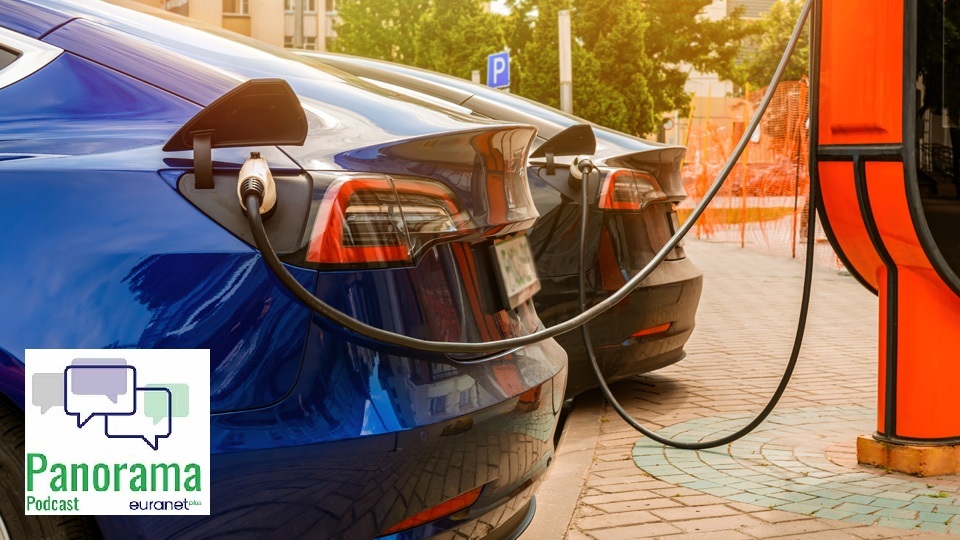
Belgium now has more than 100,000 public charging stations – yet they are not evenly distributed, with Flanders boasting more than six of them to every one that exists in the French-speaking south of the country.
But when RTBF seeks the view of Philippe Vangeel, director of EV Belgium, Belgium’s federation for electric mobility, he suggests that things have picked up markedly over the last 12 months.
Philippe Vangeel, Director of EV Belgium (in French):
“Over the course of a year, we have doubled the number of ultra-fast charging stations. Already, one in three cars sold in Belgium today is 100-per-cent electric. If we continue on this path, which is gaining momentum too, we should reach more than 200,000 public charging stations in Belgium.”
The European Commission wants to see a ‘pool’ of fast charging stations every 60 kilometres on motorways by 2026, and this is certainly still far from the case in the south of Belgium, despite the great progress being made. The Netherlands leads the field, home to around 20 per cent of all the public charging points in the EU.
In Bulgaria and Romania, though, the picture looks significantly less rosy. Here, there are only 1.2 charging stations per 100 kilometres, reports BNR, while the city of Hamburg alone has more stations than Bulgaria and Slovakia combined.
The chair of the Bulgarian Oil and Gas Association, Svetoslav Benchev, queries, though, whether putting the focus on charging stations is a bit like putting the cart before the horse.
Svetoslav Benchev, Chair of the Bulgarian Oil and Gas Association (in Bulgarian):
“It’s like the chicken and the egg question – which should come first: electric cars or charging stations? Market logic says that electric cars should come first, but the European Commission says it should be charging stations.”
While Benchev’s argument is understandable, it is clear that nobody will be interested in buying an electric vehicle that they will struggle to charge.