Protests, protests everywhere (part 1)
Euranet Plus Panorama is a weekly news review that showcases our network’s wide-ranging coverage of EU-related stories.
Adaugă ca sursă preferată în Google
Radio România Internațional, 26.10.2026, 15:54
As a wave of protests continues to spread around Europe, opinions are divided on what lies behind them – and how to respond to them.
With national reporting sometimes seeming to overlook the wider social discontent brewing at a global level, we hope this two-episode series will do what Panorama does best: zoom out to provide a bit of European perspective.
Popping up all over the shop
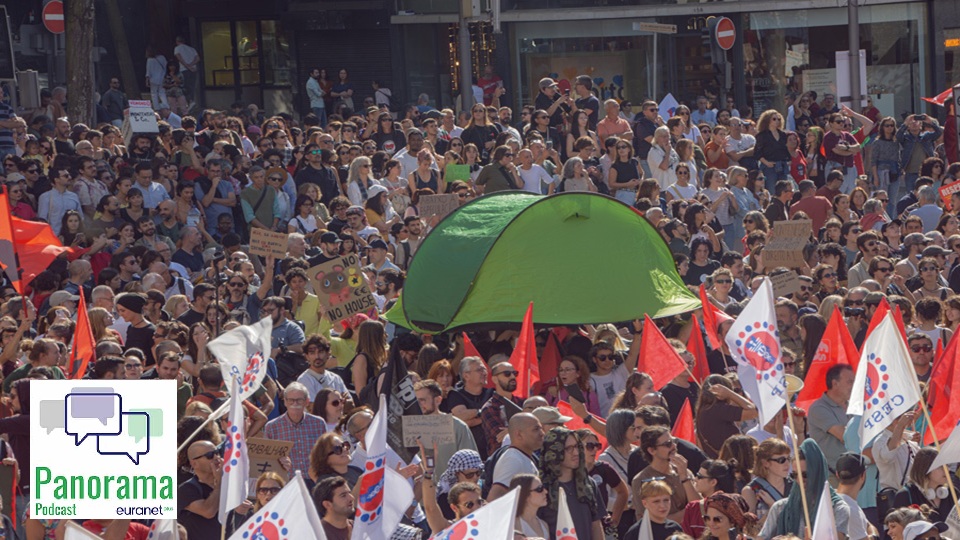
You would have to have been living under a rock to fail to notice the surge in demonstrations across Europe [add map] of late. Major cities across the bloc are drawing large crowds, with young people in particular out in force.
The demonstrations are, at least on the surface, driven by the rising cost of living, discontent with the education system and other public services, and a housing crisis.
For example, over the last few months, and particularly in recent weeks, housing protests and teachers’ protests have been taking place simultaneously across Spain. While the two movements may not strictly overlap, says Borja de Madaria, a professor of sociology and social anthropology at the University of Valencia, both reflect broader social discontent regarding the state of the country’s economy and public services. He is talking to esRadio.
Borja de Madaria, Professor of Sociology and Social Anthropology (in Spanish):
“They all stem, in a general sense, from a certain degree of neglect of the public education system by the very institutions that are in theory tasked with safeguarding it. What they all have in common is that they bring these demands to the table: issues regarding funding, the management of resource shortages, and the maintenance of the school buildings themselves.”
For her part, Paola de la Cruz, a high-profile teacher who won the award for Spain’s Best Early Years Teacher in 2020, is extremely concerned about deteriorating wellbeing among her colleagues, not to mention the clear knock-on effect this has on pupil wellbeing.
Paola de la Cruz, Early Years Expert (in Spanish):
“Teachers’ health is paramount in the classroom. When a child arrives, they look for that connection, that point of reference, and that person – the teacher – must be in top form: healthy, active and happy. They cannot be in poor emotional health; they cannot be taking diazepam. And in some cases, our schools really are run by teachers who are on diazepam. That is inconceivable.”
Obviously, but does she have any solutions to suggest?
Paola de la Cruz, Early Years Expert (in Spanish):
“Most education policy is drawn up by people who have never run a school, who have never worked with children and who are unaware of the needs of those involved. […] If that education policy were drawn up by people with experience in schools, people who have managed them, it would be a whole other story.”
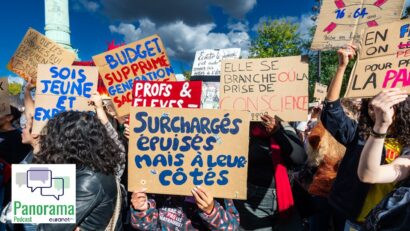
Meanwhile, in France and Belgium, it is primarily school pupils who have taken to the streets to spearhead protests about the state of the education system.
This said, none of the protests are clear-cut as they involve diverse voices and groups, each with its own agenda. But for Belgian economist Bruno Colmant, our consumerist society lies at the root of many of the demonstrations, as he tells RTBF.
Bruno Colmant, Economist (in French):
“It’s not only France. We’re seeing protests in Lisbon, Milan, Brussels and Liège too. […] In my view, this is an expression of a hyper-consumerist society that’s becoming psychotic. And we can see that the demonstrators – who, incidentally, are extremely violent – are attacking shops. They want to consume; they want to be part of this consumer society that has long been the stuff of their dreams. I think this reveals a deep-seated unease in society regarding our relationship with consumption, with material things.”
In case this seems a little far-fetched, Colmant elucidates further.
Bruno Colmant, Economist (in French):
“My intuition is that globalisation, which has brought us so many innovations in goods and services, is leading to populism […]. We have the sense that wealth is within our grasp, while in fact we live on a continent that is gradually becoming poorer. This creates a disconnect in people’s minds between what they believe they can become and the reality of their purchasing power. In my view, we have a global problem stemming from the fact that the centres of growth have moved away from the Western world to other places. And artificial intelligence and digitalisation are exacerbating this tension. We are under the impression that everything is delivered in an almost seamless and fluid manner, but we are stuck in a society that no longer has much growth.”
Who stands to gain?
Whatever is bringing people out onto the streets, it certainly does look like populist parties are set to gain from the political unrest, says political analyst Gintas Karalius from Vilnius University.
Karalius argues, in a conversation with Žinių Radijas, that French president Emmanuel Macron has failed to demonstrate leadership during the crisis, while Marine Le Pen stands to gain from the ever-weakening political centre.
Gintas Karalius, Political Scientist (in Lithuanian):
“Macron’s speech yesterday was very weak. He is starting to look like a mere commentator rather than a decision maker. He seems more interested in foreign policy, as if domestic affairs are no longer his concern. He is a politician on his way out who no longer wants to get his hands dirty. And today, his government […] suggested they might introduce a curfew. In short, it all comes across as very weak. These do not look like real decisions. The political centre appears to be giving up. This is good news for Marine Le Pen ahead of the elections in six months’ time. It suits her if Jean-Luc Mélenchon, from the far left, gains strength, because she would easily defeat him. In her speech yesterday, in which she condemned the protesters, she did not overtly blame the far left for the violence, pointing the finger at Macron instead. The aim is to weaken the political centre ahead of the presidential election in six months’ time.”
As protests spread across Europe, Lithuanian MEP Virginijus Sinkevičius, a member of the European Parliament’s Greens/EFA group, warns that mainstream political parties risk losing public support across the board if they fail to address people’s grievances. Radical movements benefit from social division, he argues, and political leaders must act before extremists take control of the public debate.
Virginijus Sinkevičius, Member of the European Parliament – Greens/EFA, Lithuania (in Lithuanian):
“I would not ignore the most important point here: what is actually bringing people into the streets. Yes, France undoubtedly has a long history and culture of protest, but radical political forces are driving these demonstrations, and this kind of division within society is extremely beneficial to them. That is precisely what they want. It turns into a question of who will reach 51 per cent. It doesn’t matter if 49 per cent of society is completely against you. If you have that 51 per cent, you are in the driving seat. For mainstream political parties, the only way forward is to take action and deliver solutions. I keep saying the same thing in Lithuania, including in relation to our government: if we ignore what is happening on the street and allow radicals to take over the narrative – which they will inevitably exaggerate and distort – then we will lose this battle too.”
External forces?
It is clear that various internal political forces are taking advantage of the chaotic situation that has arisen in various European countries. At the same time, some commentators are suggesting there are also external forces at play – namely, Moscow.
But this argument holds little sway for Ilmar Raag, an influential Estonian screenwriter, film director, and former communications advisor to the Estonian government who has spent many years in France. Instead, Raag stresses to Kuku Raadio that the origins of France’s social upheaval have been a long time in the making.
Ilmar Raag, Communications Professional (in Estonian):
“I do not believe that Russia had a hand in the initial outbreak of these protests, because the problems facing French society are longstanding and very serious. I will give just one example that always amazes me. It is said that the last time France’s state budget was balanced was in 1974. Since then, the budget has been constantly in deficit, and the state has been borrowing more and more all the time. Today, France’s public debt accounts for 119 per cent of GDP. This is unbelievable. The country has reached the point where the cost of servicing its debt is higher than, for example, its defence budget.”
Leonardo Bianchi is an Italian writer and journalist specialising in social movements and digital culture. In an interview with Radio 24, he makes it clear that he is also of the view that the protests are “homegrown”.
Leonardo Bianchi, Writer and Journalist (in Italian):
“Let me say straight away that I don’t think there is any external interference from third countries. This seems to me to be something very organic, very homegrown. […] What we have seen in Milan, but also in Turin and Bologna, is a kind of evolution of what we saw in Italian squares last year in support of Gaza, now linked to issues such as the cost of living, education, inflation, rising petrol prices, and so on. Back then, too, there was a way of mobilising people in which there were no movements, no associations. In other words, nobody really had control over those demonstrations; nobody was directing them. Instead, it was a form of spontaneous gathering around specific issues, around particular slogans, without the traditional forms of mobilisation that usually characterise protests.”
Speaking to Renascença, Francisco Rodrigues, chair of Portugal’s Observatory on Security, Organised Crime and Terrorism, admits that while it is quite possible that Russia has a hand in some of the protests erupting all over the bloc, this is unlikely to be the whole story.
Francisco Rodrigues, Chair of the Observatory on Security, Organised Crime and Terrorism (in Portuguese):
“Several European governments are pointing the finger directly at the Russian state, but there may also be interference here from so-called ‘inorganic groups’ – that is, groups that are not organised or formalised, whether they are linked to associations or political parties, which take advantage of the situation to cause chaos.”
And does he think the protests against the rising cost of living – in particular housing – currently playing out in Portugal form part of Russia’s so-called hybrid war against the EU?
Francisco Rodrigues, Chair of the Observatory on Security, Organised Crime and Terrorism (in Portuguese):
“No, I think that in the Portuguese case we are witnessing a process of mimicry – the copying, transposition and imitation of what is happening in some European countries.”
Next week, we will consider the premise that at the heart of these protests is simply a demand to be heard on the part of the younger generation.