Kubilius: “We need much more political unity in the leadership on defence issues”
Euranet Plus Panorama is a weekly news review that showcases our network’s wide-ranging coverage of EU-related stories.
Adaugă ca sursă preferată în Google
Radio România, 20.04.2026, 10:29
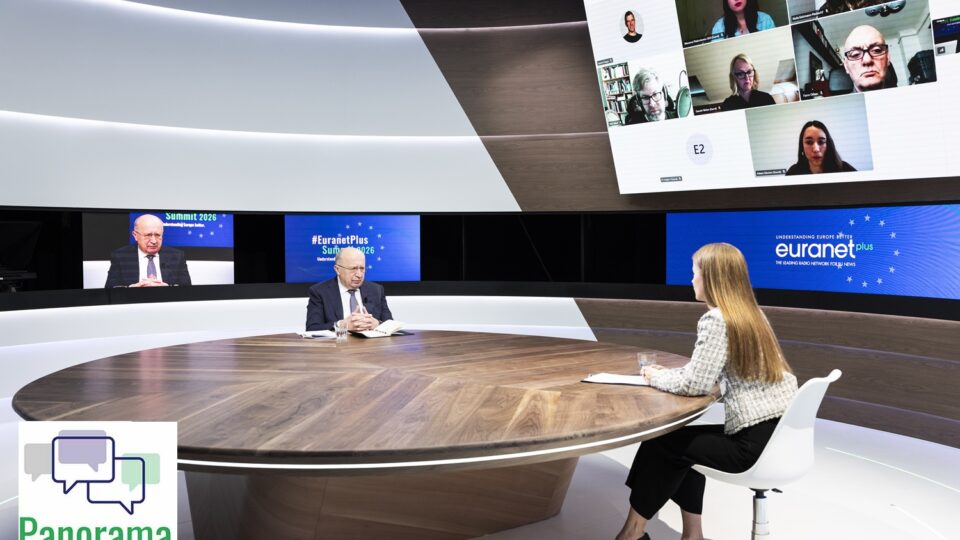
Andrius Kubilius, the European Commissioner for Defence and Space, answers questions from moderator Aušra Jurgauskaitė and a panel of Euranet Plus journalists at our Euranet Plus summit.
As the EU faces its biggest security crisis since its creation, the first-ever “European commissioner” hat has been given to veteran Lithuanian politician Andrius Kubilius – a former prime minister and member of the European parliament. However, this comes with multiple headaches, the most pressing of which are the war in Ukraine, the growing threat posed by Russia to the continent, and the Trump administration’s ‘NATO 3.0’ vision.
‘Forged in crises’
The 2026 US National Defence Strategy shifts American defence priorities, redirecting the focus of the American powerhouse to the Indo-Pacific and the ‘Western hemisphere’. Based on the premise that European nations are wealthy enough to ensure their own defence, the US is relegating its role on the European continent to a secondary position within NATO. NATO 3.0 is a new partnership in which the United States’ support is conditional on other alliance members meeting defence spending targets of at least five per cent of their GDP and reducing their dependency.
The challenge for Europe is abysmal, but as Andrius Kubilius quoted Jean Monnet, the ‘father of Europe’, as saying: ‘Europe will be forged in crises and will be the sum of the solutions adopted for those crises’. So, the defence commissioner points out, Europeans must now stand on their own two feet and jointly find their own solutions to develop credible military capabilities.
In fact, for decades, the United States has been the enabler of Europe’s defence, providing cutting-edge military capabilities, technologies and infrastructure. Between 80,000 and 100,000 U.S. troops are also stationed on the continent, a presence that US President Donald Trump has regularly threatened to withdraw.
In this context, is the commissioner in favour of establishing a European army? asks Aušra.
Andrius Kubilius, European Commissioner for Defence and Space (in English) 1
“If Americans start to remove those troops from the European continent, then we need to look also at how to replace them. And that is where it comes to this idea, or one of the possible solutions that we need to create a similar type of military force, a European military force, which could play a similar role. And that role is to be something like a rapid reaction force. […] We can call that a European army; we can call that a European rapid reaction force… but what we need to understand is that this is not a replacement of national European armies: it’s a replacement of the American troops which are now located on the European continent.”
Unlocking potential
In order to reduce its dependency on foreign suppliers, Europe has embarked on a rearmament wave. Brussels has proposed loans to support member states ramp up production and accelerate the scaling up of the EU defence industry.
However, as Kubilius acknowledges during the debate, this defence industry is highly fragmented, the result of decades of uncoordinated defence policies and spending. SKAI journalist Marianna raises concerns about the coordination issues and delays that frequently arise in defence projects involving collaboration between several EU countries and wonders how the EU could improve cooperation between member states to speed up the implementation of these joint projects.
While the EU has launched several initiatives meant to overcome these obstacles, Kubilius notes that it always all comes down to one and only issue: a lack of leadership in EU defence.
Andrius Kubilius, European Commissioner for Defence and Space (in English) 2
“What is important to understand is that, in order really for Europe to be able to be much more successful in the development of big pan-European projects – like the Drone Defence Initiative, like the Eastern Flank Watch, or the Air Defence Shield – we need to have much more of political unity in the leadership of the European Union among member states on defence issues. That still needs to come.”
Meanwhile, the European Union remains heavily dependent on the United States for its weapons supply. The issue now is that even increasing spending may not be enough right now. The war in Iran has depleted some US stockpiles, creating supply shortages.
Europeans continue to rely heavily on Washington for both arms deliveries to Ukraine and their own rearmament. Mart, from Estonian Kuku Raadio, questions the bloc’s defence chief what short-term solutions are available under these circumstances to ensure the supply of weapons to Ukraine.
Andrius Kubilius, European Commissioner for Defence and Space (in English) 3
“It appears that Ukrainians are much more able [than the EU] to quickly surge production of different weapons […]. What we need to see as a bigger issue, is that at the moment, despite all our investments into defence, Russia is outproducing us – quite heavily. And that really is a bad tendency. For example, in the production of cruise missiles, Russia is producing per year around 1,200 missiles. We, in the European Union, were able to produce around 300. Ukrainians last year started to produce cruise missiles, so-called Flamingos: this year they will produce around 700. The Russians are producing per year around 1,000 ballistic missiles, which were used to attack Ukraine. We are not producing [them] at all in Europe, [while] Ukrainians are starting to produce this year their own ballistic missiles.”
This suggests that EU support for Ukraine could extend beyond simply supplying weapons to helping the country develop its own arms industry.
So when Danièle, our colleague from Luxembourg’s Radio 100.7, asks the defence commissioner what he thinks of Ukrainian president Volodymyr Zelensky’s recent suggestion that Ukraine should join a common defence system, his answer is straightforward.
Andrius Kubilius, European Commissioner for Defence and Space (in English) 4
“I see a lot of rationality in what President Zelensky was and is speaking about. […] First of all, we need to understand that, if Putin decides to start an aggression against NATO or EU member states, somewhere in the neighbourhood of Russia, as our military intelligence always is warning us, then we shall face a Russian battle-tested army, which is able to use millions of drones – Ukrainians are predicting that this year the Russians will be able to use around 7 or 8 million drones. So, the Russian army is today much stronger than it was back in 2022. And on our side, among EU members or members of NATO, we do not have such battle-tested experience, only Ukrainians have it. So, from that point of view, to look into possibilities of how to integrate both battle-tested Ukrainian industrial capabilities and military capabilities would be a very strong, a very big added value to the development of our European defence capabilities.”
Towards a European defence union
Andrius Kubilius believes that Ukraine should play a part in a genuine European Defence Union.
But what is the underlying logic for achieving this? And what is the way forward?
Andrius Kubilius, European Commissioner for Defence and Space (in English) 5
“We need to look at how to create some kind of a broader system of defence, which would be broader than the European Union, and which would also allow us to overcome such problems such as some countries, for the time being, not agreeing to have Ukraine as a member of NATO. That is why the idea which is called the European Defence Union […], that idea is what we are working on.”
The Lithuanian commissioner advocates a bold vision involving the ratification of a new pan-European, intergovernmental treaty on defence. This approach offers numerous advantages, as he explains to Euranet Plus.
Andrius Kubilius, European Commissioner for Defence and Space (in English) 6
“It will demand, maybe […] a new additional intergovernmental treaty, which would allow us to establish some kind of network of different member states, united for common defence:- having as a leadership, what we call a European Security Council; – being able to make decisions on a majority voting principle, not being blocked by anybody who wants to veto everything; – and then perhaps also such a treaty could have clear provisions also about the possibility of creating a European army, which we were talking before. So this idea of a European Defence Union, where among EU member states or next to EU member states, we could have also the United Kingdom, Norway, Ukraine, maybe some other countries, that’s what I see as a very important perspective.”
Space mission: down to earth
Kubilius is not only responsible for defence: space is also part of his portfolio. Our colleague Neža, from Austrian radio station Agora, asks him about the bloc’s space ambitions, particularly in light of NASA’s recent Artemis II milestone. Will we ever see European astronauts on the Moon?
Andrius Kubilius, European Commissioner for Defence and Space (in English) 7
“We should not forget that some very important components in that mission were produced by Europeans. And this spaceship, Orion, would not be able to reach the Moon without the European propulsion system. I will not go into the details, but we can be proud that we were also part of that mission. Now, you know, I cannot predict when Europeans also, as astronauts, will land on the Moon, but we are quite active with the exploration of the Moon, and perhaps we shall expand our programmes using different robotic instruments.”
When it comes to space policy, the commissioner calls for both feet to be kept on the ground. Although the Union may enter the space race later than the US, it has other strengths in space exploration. Its main focus is engineering, precision, and long-term systems, and it often produces technology of a very high standard, including for Moon exploration.
This could involve robotic missions rather than human missions, for example.
Andrius Kubilius, European Commissioner for Defence and Space (in English) 8
“Usually, we are not so good at some kind of „romantic” – you know, „first movers into new frontiers” – we are good at coming up with good technologies in the development of those frontiers. That has happened, for example, with Galileo: we were late in starting to develop our navigation system, but now it’s the best system in the world. The same with Copernicus. So, I think that we shall be in the future on the Moon, maybe with a specific European approach. But definitely we need to understand that a totally new era in exploration of space has started with the Artemis II mission.”