Panorama 11.07.2025
Euranet Plus Panorama is a weekly news review that showcases our network’s wide-ranging coverage of EU-related stories.
Adaugă ca sursă preferată în Google
Radio România Internațional, 14.07.2025, 18:14
Copenhagen commands the Council
With an acknowledgement that the world is “changing”, Denmark charts its course towards a stronger Europe.
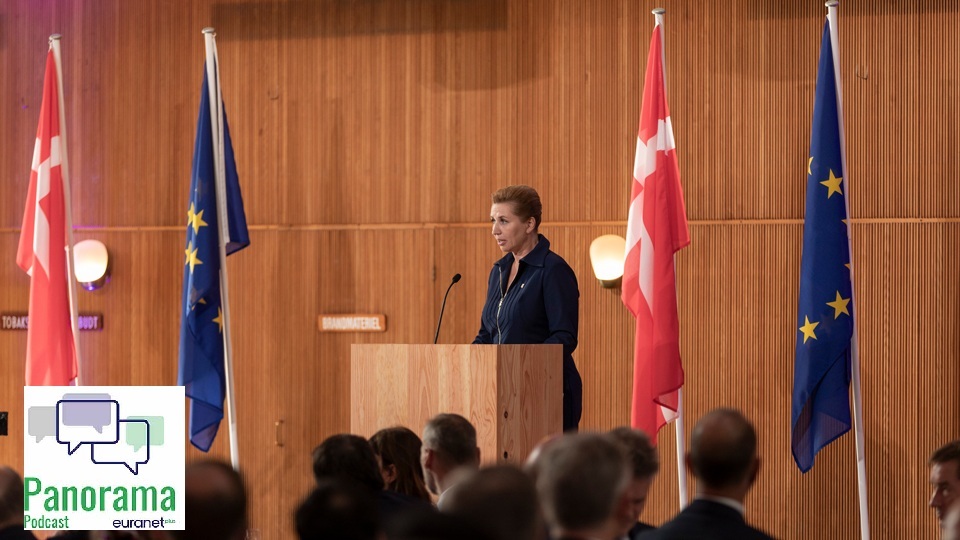
During Tuesday’s plenary session in Strasbourg, Danish prime minister Mette Frederiksen presented her country’s programme for the rotating Council Presidency, which it took over on 1 July. Its motto? ‘A strong Europe in a changing world’.
Two key priorities
Historically seen as a somewhat sceptical and ‘frugal’ member state, Denmark has recently changed tack, adopting a noticeably more pro-European and dynamic stance in light of the challenges facing the EU.
This observation is backed up by Lithuania’s ambassador to Denmark, Asta Radikaite. In an interview with Žinių Radijas, she recalls a recent conversation with the outgoing German ambassador t’so Denmark.
Asta Radikaite, Lithuanian Ambassador to Denmark (in Lithuanian):
“He said that the biggest impression he is left with from his time in Denmark is the change in Denmark’s position. When he arrived, Denmark was considered, to put it mildly, Eurosceptic. Now it is one of the biggest supporters and drivers of European politics.”
The Danish presidency’s vision will be important as Europe forges ahead through particularly choppy waters over the next six months. With wars on Europe’s borders, tensions with China, extreme instability in the Middle East, transatlantic relations in flux, the threat of a trade war, and internal tensions being whipped up by populist parties (even governments) within Europe, responsiveness and creativity will be the watchwords.
Ave Schank-Lukas, Acting Head of the European Commission Representation in Estonia, sums up the two main priorities of this Council presidency for Kuku Raadio’s listeners.
Ave Schank-Lukas, Acting Head of the Commission Representation in Estonia (in Estonian):
“On the security side, the Danish Presidency is determined to move forward with the initiatives that were pursued quite actively during the Polish Presidency. One of these is preparedness for 2030, by which time the European Union should be able to defend itself.”
And what about Denmark’s second priority: a “competitive green Europe”?
Ave Schank-Lukas, Acting Head of the Commission Representation in Estonia (in Estonian):
“Above all, it is important to move forward with reforms that improve the business environment, allow companies to grow and create a basis for innovation, investment in new technologies and skills. And, of course, it is very important to reduce the administrative burden. This is an issue on which the European Commission has been very active and has made concrete proposals, which have already been approved. In particular, to relieve companies of various reporting obligations, but also to simplify, for example, the building up of the defence industry.”
Defence
So, let’s begin with security and defence. The Commission has presented its first legislative proposals in these areas and the Danes’ job will be to lead the negotiations between member states in the Council, and those between the Council and the European Parliament.
The key question is how to finance preparations for defence independence in 2030. An agreement on the 150-billion-euro SAFE loan facility has already been reached. Meanwhile, just over half of member states have decided to activate the national safeguard clause of the Stability Pact to spend 1.5 per cent more of GDP on defence.
The next step is to identify what needs to be financed jointly, and it is significant that Denmark itself is not rejecting the idea of joint financing from the outset.
Yet, in a recent interview with our Portuguese colleagues at Renascença, German economist and commentator Wolfgang Münchau expressed his strongly held view that the bloc will remain reliant on the US for security for at least a decade to come, despite its increased defence spending.
So, why does he think this?
Wolfgang Münchau, Economist and Commentator (in English):
“Because military independence is not about how much we spend. It’s about how we spend it, how we organise it, what capabilities we have. Things are more expensive. For example, ammunition in Europe is so much more expensive than it is in the United States. And Russia pays a fraction of the cost. So the fact that we’re spending more money basically means that we’re kind of stupid. Instead of actually trying to get more for the money we spend, we’re trying to spend more money. And that actually isn’t going to help.”
The Danish Presidency will also push for broad security proposals to counter hybrid threats, such as cyberattacks and sabotage, with a particular focus on the Baltic Sea. And take forward recommendations from the Niinistö report on civil and military preparedness.
Economy and competitiveness
On the economy and competitiveness, the reports by Mario Draghi and Enrico Letta will guide the new presidency. But apart from the Omnibus packages on simplification – which are entering the negotiation phase between the Council and the European Parliament – little progress has been made in this area to date.
Morten Jespersen, Denmark’s ambassador to Latvia, highlights his country’s priorities here in a conversation with Latvijas Radio.
Morten Jespersen, Danish Ambassador to Latvia (in English):
“On competitiveness and green Europe, it’s all about highlighting the burden reductions and simplification. It’s about strengthening the single market. It’s about ensuring an open trade policy, including, I would say, diversification of supply chains. It’s also [about] continuing the green transition. That includes better and easier access to clean energy. And of course, we also have to agree on a 2040 climate target.”
On the overlapping subjects of more diverse supply chains and the green transition, Denmark will launch negotiations on the Commission’s proposals to completely abandon Russian oil and gas. The question is, how can this lofty goal be achieved?
Our Luxembourgish colleagues from 100,7 were in Aarhus, Denmark, for the formal opening of the Danish presidency. Significantly, Aarhus is the site of Europe’s largest geothermal plant, which is currently under construction.
The EU’s energy commissioner, Dan Jørgensen – who is, incidentally, also Danish – took the opportunity to show his support for making geothermal energy more widespread.
Dan Jørgensen, EU Commissioner for Energy (in English):“We know for a fact that 20 per cent of all bigger cities in Europe, geologically speaking, have the potential to do the same. And at a time when we are desperately looking for sources of energy that can help us to get rid of our dependency on fossil fuels, this is extremely good news.”
And what of nuclear power, something that Denmark itself has long been vocally opposed to? Well, Jørgensen, who in his former role as Danish energy minister fought an anti-nuclear battle at EU level, notably stated in Aarhus that nuclear power “remains part of our strategy in Europe”.
And the country’s current energy minister Lars Aagaard agrees.
Lars Aagaard, Energy Minister of Denmark (in English):
“You need a combination of technologies. Nuclear must be part of the solution.”
So it seems like the nuclear tide really is turning in Denmark. This said, nuclear power plants are expensive and in no way a quick fix, taking many years to start producing electricity. So for this reason, Aagaard points out, other solutions will be preferred.
Lars Aagaard, Energy Minister of Denmark (in English):
“I think, for market reasons, personally, I think renewables will be dominant. But the market will decide.”
Migration
On migration, the position of Danish premier Frederiksen, whose party belongs to the European socialist family, is closer to that of right-winger Giorgia Meloni than to that of fellow socialists. Indeed, alongside Meloni, she is a member of an informal group within the Council that is striving to toughen migration policies.
Mette Frederiksen, Prime Minister of Denmark (in English):
“European citizens have a right to feel safe in their own countries. That is why we need to strengthen our external borders. We have to lower the influx of migrants to Europe. We need to help stabilise Europe’s neighbouring countries and make the process of returns easier.”
That was Frederiksen. And Asta Radikaite, Lithuania’s ambassador to Denmark, underlines that this will be an area of strong focus for the Danish presidency.
Asta Radikaite, Lithuanian Ambassador to Denmark (in Lithuanian):
“They are in fact using all the tools at their disposal to persuade member states to adopt a stricter migration policy, not towards refugees fleeing war – because here, for example, we can talk about Ukrainians in Denmark, who are very well integrated – but those who are looking for a better life and do not necessarily contribute to the prosperity of their countries. Starting with a few like-minded countries a couple of years ago, there are now probably around 15 member states that support Denmark’s position, and I believe that Denmark will use all the instruments at its disposal during its presidency to consolidate this position.”
Danish ambassador Jespersen, in Latvia, points out that this will include continuing one important aspect of the work of the Polish presidency.
Morten Jespersen, Danish Ambassador to Latvia (in English):
“That also includes addressing, continuing to support, what Poland has been focusing on through their presidency. That is the instrumentalisation of migrants. We know what we are talking about. Russia and Belarus are using migrants as a political instrument at our external borders. The purpose is, among others, to try and destabilise Europe.”
Greenland
And, of course, Denmark is going to have to deal with a challenge where it finds itself on the front line, after the US president announced his intention to annex Greenland, an autonomous territory under Danish sovereignty.
But José Manuel Barroso, a former Portuguese PM and Commission chief, tells Renascença that Denmark will undoubtedly play down the Greenland issue during its presidency so as not to further weaken transatlantic relations.
José Manuel Barroso, Former President of the European Commission (in Portuguese):
“The Danes, with their Nordic pragmatism, are trying to prevent this from becoming a central issue, not least so as not to pollute relations with the United States.”
Ambassador Radikaite is in agreement.
Asta Radikaite, Lithuanian Ambassador to Denmark (in Lithuanian):
“Indeed, Denmark is using all its diplomatic channels to resolve this issue as smoothly as possible, without making it public, and I do not think that this will be on the European Union’s agenda.”
With other areas of focus including enlargement and rethinking the EU’s long-term budget, it seems that Denmark may be setting its sights a little high for a mere six-month tenure. Yet, as Prime Minister Frederiksen stressed in her opening address, the key thing is to safeguard the very premise of the European Union: its fundamental values and its spirit of cooperation.
Mette Frederiksen, Prime Minister of Denmark (in English):
“Europe is first and foremost an idea. It is the way we think. Our fundamental values, freedom, democracy, the rule of law, our firm belief in progress, science and common sense, that we always seek to make tomorrow better than today, our social model, that we are free to think as we want, believe what we want, and speak as we see fit. These are the fundamental ideas on which our continent is built, and they run in the blood of all Europeans. Europe is cooperation, discussions and difficult compromises. But above all, Europe is a magnificent, rich and diverse continent that has managed to rise again and again.”
Uplifting words.