Ready, steady, NO!
Euranet Plus Panorama is a weekly news review that showcases our network’s wide-ranging coverage of EU-related stories.
Adaugă ca sursă preferată în Google
Radio România Internațional, 22.06.2026, 19:56
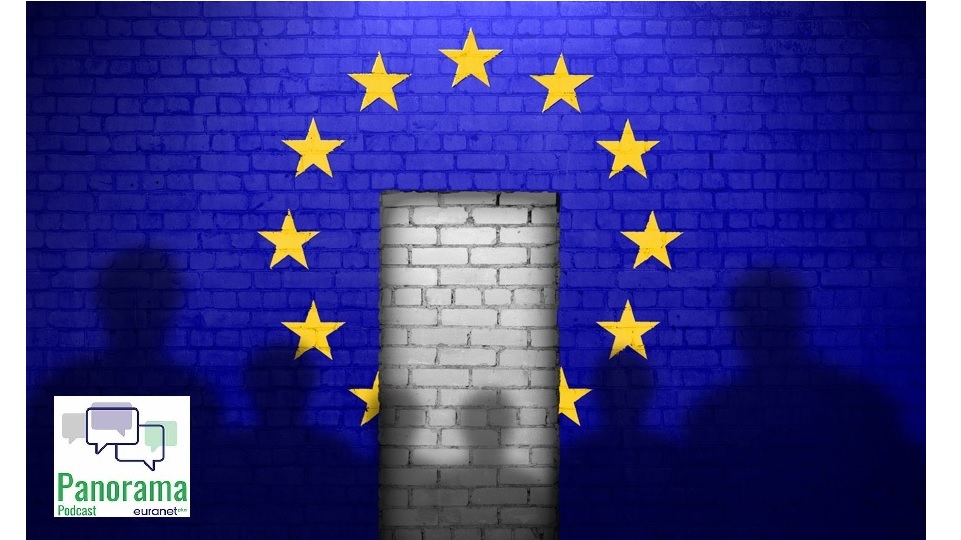
The EU’s long-awaited, and much-debated, Pact on Migration and Asylum entered into force on 12 June. Whether it strikes the right balance, though, remains questionable.
The pact contains clear rules on responsibility for processing asylum applications, strives to reduce illegal entries, and sets out solidarity measures between member states that aim to ease the burden on those countries where most migrants tend to arrive.
Pros and cons
Judith Kohlenberger is a migration researcher at the Vienna University of Economics and Business. She discusses the pact’s pros and cons in an interview with Agora.
Judith Kohlenberger, Austrian Migration Researcher (in German):
“The asylum package was always intended as a compromise, although it must be noted that the focus is now on tightening the rules, and this is very much in line with the wishes of the vast majority of member states. I would argue that, overall, the loss of rights for those seeking protection outweighs the benefits, given the prison-like conditions that are likely to prevail at the external borders, the possibility of accelerated border procedures and the comprehensive collection of biometric data. What could be seen as structural progress – and thus also a benefit of cooperation – is the mandatory solidarity mechanism, under which each individual country is obliged either to take in refugees or to provide financial compensation. However, it will only become clear during the implementation phase whether this commitment is backed up by action.”
What does she mean by this?
Judith Kohlenberger, Austrian Migration Researcher (in German):
“There are, after all, some member states, such as Hungary and Slovakia, which have already stated that they do not intend to implement the pact, and in particular the solidarity mechanism. Yet this is actually at the heart of the reform, and other elements depend on it. We are already seeing that implementation is stalling in many other member states for purely logistical reasons: for example, screening cannot yet be carried out, the digital infrastructure required for comprehensive data collection is lacking, or there is a shortage of staff and training for those staff.”
But, a few logistical hurdles aside, a majority of member states seem happy with the basic premise of the pact, don’t they?
Judith Kohlenberger, Austrian Migration Researcher (in German):
“My guess is that the restrictive aspects of this pact – such as the presumption of non-entry, detention rules and border procedures – are the most likely to be implemented in practice, because this is politically expedient in the vast majority of member states. Meanwhile, however, protection standards, solidarity and greater rights – at least on paper – for young refugees are likely to be implemented only hesitantly, if at all.”
On the other hand, says Margarita Šešelgytė, director of Vilnius University’s Institute of International Relations and Political Science, to Žinių Radijas, although the pact’s solidarity aspect is attention grabbing, the new pact has a great deal more to offer than this.
Margarita Šešelgytė, Professor of International Relations (in Lithuanian):
“It is important to stress that this pact is not only about redistribution and solidarity. It contains many technical elements, including the screening of migrants, the streamlining of procedures, the return of migrants to the countries through which they entered, as well as broader return mechanisms. As such, it addresses many of the problems the EU is facing today. […] Another important element is that it addresses the instrumentalisation of migration. […] By acknowledging this problem, opportunities arise to apply stricter measures, so that if migration is used as part of a hybrid attack, it can be treated differently.”
Views from the frontline
Gemma Pinyol-Jiménez is head of migration policies at the Barcelona-based ‘think-and-do tank’ Instrategies. She is also a member of the interdisciplinary research group on immigration at the city’s Pompeu Fabra University.
Countries like Spain, she tells esRadio, find themselves in a complex situation. They are looking at having to establish a system of closed centres to carry out initial assessments before people can ‘officially’ enter the country and apply for asylum.
Gemma Pinyol-Jiménez, Head of Migration Policies at Instrategies (in Spanish):
“How do you manage a border that isn’t a border? Where do you place people who are in the European Union but also aren’t, while you determine whether they can enter EU territory and apply for asylum or not? […] How are the police supposed to have the training to determine, in so little time, whether or not a person is eligible to apply for asylum? All these elements – day-to-day practice, if you like – are the things that remain unclear and concern us, because they have not been the subject of debate. The debate has been very general.”
Pinyol is referring to the new screening procedure, which obliges member states at the bloc’s external borders to carry out a series of administrative checks within just seven days. Third-country nationals are not considered, from a legal point of view, to be present on EU territory, despite being physically present there, until they have ‘passed’ this stage. Some of them will receive an almost automatic refusal – people, for example, who come from so-called ‘safe’ countries from which no more than 20 per cent of applicants are granted international protection.
In another of the bloc’s frontline states, Thanos Plevris, the Greek minister for migration and asylum, is talking to our colleagues at SKAI Radio.
He points out that Greece has effectively reset its Dublin Regulation return obligations to zero through bilateral agreements concluded with key EU countries – namely Germany, France, the Netherlands and Belgium. These countries have agreed to take responsibility for all existing cases resulting from secondary migration flows from Greece up to the pact’s entry into force on 12 June.
But what about going forward? Surely Greece will still be in line for a lot of intra-EU ‘returns’, as secondary migration flows on to Northern and Western European countries are unlikely to stop.
Thanos Plevris, Greece’s Minister for Migration and Asylum (in Greek):
“For this reason, with countries that receive secondary migration flows from Greece – such as Germany, the Netherlands, Denmark and Austria – we have agreed to establish return hubs in a third country. The idea is for those who would otherwise be returned to Greece under the Dublin Regulation to be transferred to that third country instead. We are already in discussions with a third country regarding the creation of these hubs.”
On Thursday (17 June), the European Parliament approved a provisional deal on the returns regulation, which among other things authorises the creation of ‘return hubs’ in third countries to which unsuccessful migrants can be transferred pending their return to their homelands.
Plevris sees the next six months as a kind of ‘pilot’ to test how the pact works in practice.
Thanos Plevris, Greece’s Minister for Migration and Asylum (in Greek):
“Everyone will have to figure it out. Many countries are not yet fully prepared, particularly those that will face the impact of secondary migration flows at a later stage. But the coming months – particularly the summer months, when migration flows are typically higher – will serve as a pilot phase. But there is a shared understanding across Europe that we need a common migration policy. The common message is that Europe protects its borders, respects those entitled to international protection, and returns those who are not.”
Pushback from the ‘richer’ countries
In fact, according to a Commission communication published in May, it seems that virtually no member state is fully prepared for implementation – even after a two-year transition period.
Nevertheless, German chancellor Friedrich Merz was feeling upbeat last week, reports AMS, as he addressed the Bundestag.
Friedrich Merz, Chancellor of Germany (in German):
“This is a significant step – indeed, the most crucial one towards resolving this problem. A shift in migration policy has begun, at both national and European level. We are already seeing a clear decline in irregular entries to Germany and Europe as a whole. This trend will continue if the Common European Asylum System reform is implemented effectively across all EU member states.”
It should be noted that Germany will avoid taking in additional asylum seekers this year, instead opting to use the new solidarity mechanism to contribute financially or provide operational support to frontline states.
Another member state that intends to take advantage of this option is Belgium.
RTBF asks Anneleen Van Bossuyt, the country’s asylum and migration minister, if Belgium will accept its fair share of the migrants arriving in frontline countries such as Italy, Spain and Greece. Her response is categorical.
Anneleen Van Bossuyt, Belgium’s Asylum and Migration Minister (in French):
“No. The pact provides for various forms of solidarity amongst member states, either through relocation – that is, taking in asylum seekers from other countries – or through financial contributions that structurally strengthen the system in countries under pressure. Given that our reception network is still at full capacity and that we are heavily affected by secondary migration, we have chosen to opt for financial contributions.”
So, Belgium will pay the requisite 20,000 euros per migrant not accepted, then – some 12.9 million euros for 2026? Not necessarily, she says.
Anneleen Van Bossuyt, Belgium’s Asylum and Migration Minister (in French):
“We are currently in negotiations with Greece and Italy to see if we can reduce this amount.”
Belgium may do this by offering operational support instead.
A note of caution
Of course, speaking of, and thinking of, migrants and asylum seekers purely in numerical terms is problematic, as Eugénia Quaresma, director of OCPM, the Portuguese Catholic Migration Service, reminds us in an interview with Renascença.
Eugénia Quaresma, Portuguese Catholic Migration Service (in Portuguese):
“There have been several voices warning the European Union about the danger of becoming too closed off. […] It is also important to invest in welcoming and integrating people. […] It is important not to become accustomed to – not to cultivate, as Pope Francis said – indifference; not to become insensitive.”
Gemma Pinyol is inclined to agree. With its strong focus on border controls, she says, the pact fails to address other key issues that really ought to be addressed in any discussion of migration management. Human rights, for instance.
Gemma Pinyol-Jiménez, Head of Migration Policies at Instrategies (in Spanish):
“I believe the debate on immigration has become a debate on the future of Europe. What sort of Europe do we want? How do we intend to maintain and protect it? There are clearly those who have a different vision of the European model in mind.”
And on that note, let’s close with a personal appeal from Mohamed Bah, a young Guinean who arrived in Europe as an undocumented migrant, but who now lives legally in the Netherlands. His words are shared by our colleagues at The Europeans.
Mohamed Bah, EU Migrant (in English):
“I hope people that will listen to this will know that we risk our lives to get a taste of lifestyle that they have; the stability that they have. And we’re not here to take jobs, we come with a gift of diversity; curious, willing to learn and ready to share.”