A summer smorgasbord: football fever, travel tolls and left leaning
Euranet Plus Panorama is a weekly news review that showcases our network’s wide-ranging coverage of EU-related stories.
Adaugă ca sursă preferată în Google
Radio România Internațional, 20.07.2026, 21:57
So, this is our final Panorama before we break for the summer and we have a delectable smorgasbord of topics for you.
What else could we begin with, of course, but the World Cup?
Football fever
Once again, football fever has swept across the globe and much of the EU will come together to back the European side fighting for the trophy in the final this weekend: Spain.
Even Italy, a football-mad nation that has somehow failed to qualify for the last three World Cups, has been following proceedings closely, as Radio 24’s sports producer Carlo Genta explains.
Carlo Genta, Sports Producer at Radio 24 (in Italian):
“Here in Italy, we’ve become a nation of voyeurs. At least when it comes to football. For the third time, we’ve been left standing at the door of the greatest celebration. We watch the others through the keyhole, wrapping ourselves in other shirts, other colours, second-string specialists, just to feel a little less alone and abandoned.”
But it’s not all fun and games, with controversy aplenty throughout this year’s tournament: sky-high ticket prices; allegations of money-grabbing over the imposed hydration breaks and extended half time, which offer lucrative advertising opportunities; Trump’s FIFA intervention over the suspension of a US striker, which led most of the world to back Belgium in the ensuing Belgium-USA match; not to mention the fact that numerous officials, staff and fans were flat-out denied entry to the US.
This said, the World Cup is somewhere everyone still wants to be seen.
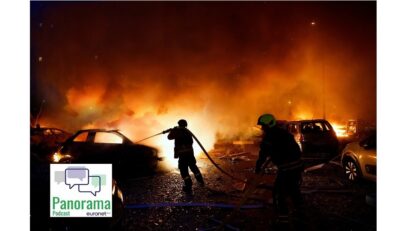
On this note, Portugal’s former socialist finance minister Fernando Medina is among a chorus of voices criticising the excessive presence of high-level politicians at the tournament. In an interview with Renascença, he openly accuses the social democrat prime minister Luís Montenegro of playing to the cameras while much of Portugal battles severe wildfires.
Fernando Medina, Former Minister of Finance of Portugal (in Portuguese):
“I think it’s completely over the top. The prime minister went a bit too far this time. When a country is in a state of emergency, its leader is away because, to put it bluntly, he’s gone to watch the football. I don’t think people understand that. Everyone can see this for what it is. I mean, at the end of one of the matches, there’s that video, that short clip of the prime minister hugging Cristiano Ronaldo. It’s a blatant attempt to win people over and gain popularity.”
Not so, says the parliamentary leader of the prime minister’s party Hugo Soares, who is quick to ride to Montenegro’s defence. Soares believes Montenegro was right to prioritise attending the World Cup.
Hugo Soares, Member of the Portuguese Parliament – PSD (in Portuguese):
“I believe this is the wish of all Portuguese people… apart from a few envious souls who do not understand, realise or appreciate the importance for the country, for our representation, and even for our preparations to host the World Cup in four years’ time – a tri-hosted tournament like this one – of strengthening these ties, but above all of being with our communities abroad and supporting our ‘heroes of the sea’ at these events.”
But not all of Portugal’s social democrats are in agreement. Academic and former minister Miguel Poiares Maduro, for example – who chaired FIFA’s Governance Committee for a year between 2016 and 2017 – makes a case for greater distance between sport and state.
Miguel Poiares Maduro, Academic and Former Politician (in Portuguese):
“I think the relationship that has developed between politics and football has gone too far. […] And I’d like to add that this isn’t merely a symbolic issue. This is an activity that the state should also regulate, so perhaps it would be healthy to maintain a little more distance.”
Travel tolls
As summer gets underway, Europeans hit the road en masse. With the rising cost of road travel of particular interest at this time of year, Luxembourg’s national broadcaster 100,7 looks at Belgium’s plans to introduce a charge for using Belgian motorways as of 1 May 2027.
Belgium’s three regions announced on Friday (10 July) that they intend to introduce a so-called ‘vignette’ system that foreign drivers transiting the country would also have to pay. Neighbouring Luxembourg’s minister for defence and mobility Yuriko Backes tells 100,7 that her government is not amused.
Yuriko Backes, Luxembourg’s Minister for Mobility (in Luxembourgish) 1:
“We are not happy about this. We regret it. What we have here is an agreement in principle between the [Belgian] regions. This will have to be transposed into legal texts, which we don’t have right now. Therefore, at this point, it is difficult to carry out a concrete analysis of whether this complies with EU law, for example.”
Indeed, Backes’ beef with the proposal is the implication that the system will target foreign drivers more than Belgians, with the latter offered some kind of tax break or similar measure to ensure the policy is ‘budget neutral’ for them.
Yuriko Backes, Luxembourg’s Minister for Mobility (in Luxembourgish) 2:
“If the toll is introduced, Belgian citizens would get some sort of discount, which means that they would be compensated for what we would all have to pay, regardless of whether we live in Belgium or are just driving through. I think this could be seen as discriminatory. And this would be similar to the German situation in 2019, when the European Court of Justice declared the measure illegal.”
Under EU law, road-charging schemes must not discriminate against foreign drivers, and Belgium will require a green light from the European Commission before it can go ahead with the scheme.
Left leaning
Let’s close this episode with a look at our natural tendency to lean left… And no, we’re not talking politics for once!
Have you ever noticed that you tend to drift to the left as you walk? Maybe not… but it turns out this is a natural human trait. Our colleagues at The Europeans podcast chat with researchers Iñaki Echeverría-Huarte and Claudio Feliciani about their offbeat discovery.
Feliciani is a Swiss-Italian academic based at Waseda University in Tokyo, specialising in the modelling, measurement and management of pedestrian crowds. Echeverría Huarte is a physicist and assistant professor at Spain’s University of Navarra, and here he introduces a quirky experiment they set up back in 2020 – the year when the expression ‘social distancing’ was on everyone’s lips.
Iñaki Echeverría Huarte, Physicist at the University of Navarra (in English):
“So, we gathered a group of volunteers and we asked them to walk inside a closed space – like a rectangular thing – while keeping an interpersonal distance with no specific goal; just trying to keep interpersonal distance. We record all the different experiments and when analysing how people move inside this arena, we identify a clear pattern regardless of the experimental conditions. In all the experimental runs, they start moving around the arena close to the walls and moving in a counterclockwise direction.”
So, is this a collective thing? Something that happens when people come together? Claudio Feliciani suggests it is not.
Claudio Feliciani, Researcher at Waseda University (in English):
“It’s not something that happens because people are together and they somehow move together; it’s at the individual level. […] So even if you have people one by one walking alone, I think if I remember well, 65 to 70 per cent of people prefer to walk to the left.”
The two researchers admit to being as perplexed as the rest of us regarding what might lie behind this natural propensity. One theory relates to biomechanics – the fact that the human body is not perfectly symmetrical and our heart is slightly off-centre to the left. Another relates to the brain and how it processes spatial information.
Echeverría Huarte is asked what purpose this fun finding could potentially serve.
Iñaki Echeverría Huarte, Physicist at the University of Navarra (in English):
“This bias could be useful to improve walking comfort in low density conditions, namely a supermarket or a museum or places where not a lot of people gather. And places where people normally follow a specific path or a specific route. If in a supermarket or in a museum, you don’t set any signals or leave people to freely choose the way they want to move, now we know that they will probably follow a counterclockwise path. So if you want to avoid congestions in specific parts of the route, if you want to improve walking comfort, so to speak, […] knowing this bias can be helpful.”
But Feliciani adds that probably the most important outcome of this research is that it will likely lead to more research.
Claudio Feliciani, Researcher at Waseda University (in English):
“Maybe people are going to do some experiments and find that like there is something, some system, that is used to keep the equilibrium in the body, which is not working very well. And maybe they discover that there is a mechanism that nobody knew inside the body, which is maybe the reason why there is this bias. And this new mechanism could help to explain why there are particular diseases. It’s a good question to start studying our body or our brain or our cognition better.”
On that note, we will sign off for the summer. Enjoy the break and we’ll be back, raring to go, from Friday 28 August.