Protests, protests everywhere (part 2)
Euranet Plus Panorama is a weekly news review that showcases our network’s wide-ranging coverage of EU-related stories.
Adaugă ca sursă preferată în Google
Radio România Internațional, 28.10.2026, 16:38
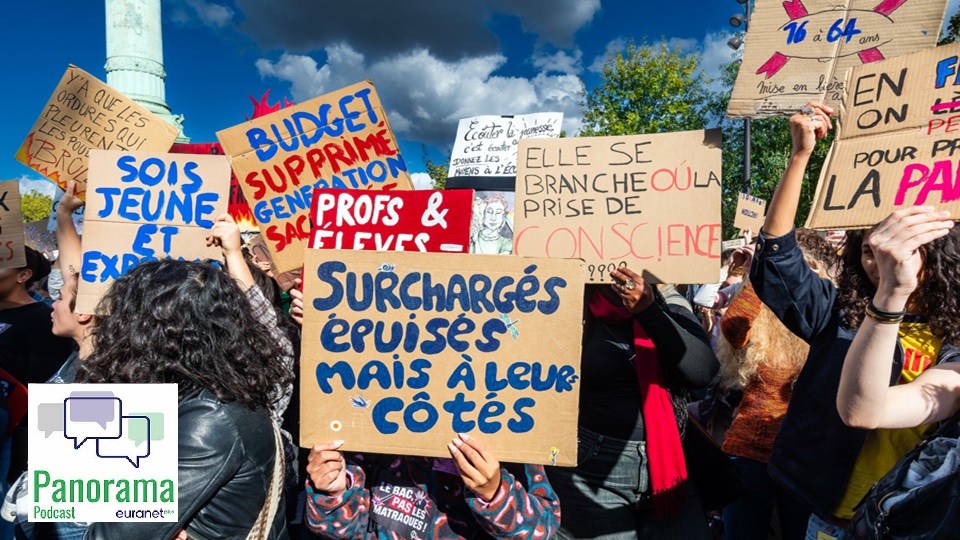
In the second instalment of our series on protests in Europe, we turn our attention to the role of young people in this somewhat disparate movement that is rapidly gathering momentum.
This comes on the back of last week’s discussion of the potential political forces behind the protests that continue to snowball around the bloc.
A youth movement in motion
According to Leonardo Bianchi, who we also heard from last week, there is no nefarious influence at play in these demonstrations. On the contrary, he tells Radio 24, at the heart of these protests is simply a generational demand to be heard.
Leonardo Bianchi, Writer and Journalist (in Italian):
“Eighteen-year-olds, or thereabouts, see that there is no place for them in the world they are entering, or at least that their prospects are bleak. They won’t be able to own their own home, they will suffer the worst effects of climate change, and they cannot even hope for any meaningful form of representation. And so they take to the streets, as has happened at other moments in history, to make their presence felt.”
As the general delegate for children’s rights in Wallonia and Brussels, Solayman Laqdim has been promoting the rights of under-18s for the past six years. He tells RTBF that the demographic shift has led to these young protestors feeling disenfranchised.
Solayman Laqdim, General Delegate for Children’s Rights
“If we are to fully appreciate what they are telling us, we need to take a step back. Firstly, we need to take a step back because we live in an ageing society, and this demographic shift is changing the way we perceive children. We often perceive young people and children as a threat and adopt a somewhat ‘adultist’ stance – that is to say, one in which we see ourselves as those who know best and can think for them. However, as the historian Pierre Rosanvallon said: ‘The tragedy of this generation of young people is that they have no representatives to champion their political agenda.’”
Laqdim agrees with Bianchi’s analysis regarding what is making young people feel they have nothing to lose.
Solayman Laqdim, General Delegate for Children’s Rights
“We are telling them: there are austerity measures; you’re going to have to tighten your belts. And even if it means that some of these young people are plunged into precarious circumstances, we are telling them that there is an armed force on Europe’s doorstep and that we must increasingly prepare for this scenario because it may well be plausible. We’re telling them that an ecological apocalypse is bearing down on them and that they’ll bear the brunt of it. We’re telling them that the mechanisms of solidarity that have existed since the Second World War are going to be eroded, or even abolished – I’m thinking in particular of pensions.”
And he goes on:
Solayman Laqdim, General Delegate for Children’s Rights
“On the one hand, they are told: ‘You must be good citizens, you must be committed, you must think critically.’ […] So these young people today are getting involved, and when they do, it causes a stir.”
Skewed by social media
In Greece, too, thousands of students, teachers and workers have taken to the streets, demanding greater funding for education, better working conditions and measures to address rising living and housing costs, with tensions spilling over in Athens.
Christos Frangonikolopoulos, professor of International Relations and Communication at the Aristotle University of Thessaloniki, does not believe that the protests have been led or prompted by any kind of coherent force. He talks to Skai about how social media is potentially distorting interpretations of what lies behind it all.
Christos Frangonikolopoulos, Professor of International Relations (in Greek):
“The simultaneous presence of thousands of protesters on the streets of Europe does not necessarily imply a shared political identity, a unified organisation or a coordinated strategy. And I think that these current European protests highlight a particular feature of this dynamic. That is to say, when you simultaneously highlight events in France, Portugal, Spain, Albania and so on through the media or social media, social media can create the impression of a unified pan-European uprising.”
Social media, he goes on, is also throwing a spotlight on certain elements of the protests to the detriment of others.
Christos Frangonikolopoulos, Professor of International Relations (in Greek):
“Another thing we are seeing – particularly following the unrest of the last few days – is that, on social media, the public debate has focused more on the clashes and the destruction. This has provoked reactions from trade union representatives and other organisations who feel that social demands are being pushed into the background.”
Christiana Papazachariou, a Greek woman who lives and works in Paris, shares the professor’s concerns that the violence and looting have overshadowed legitimate demands concerning the cost of living and weaknesses in the education system.
Christiana Papazachariou, Greek National in Paris (in Greek):
“A fundamental right – namely the right to protest – is being hijacked by violence, and that violence then simply becomes the focus of attention, while everything that the citizens and students were protesting about is forgotten. Their expression of dissatisfaction with the cost of living – a sentiment shared, I believe, by millions of citizens across Europe – and the students’ demands for a high-quality education, which is, I think, an ideal that underpins European society. Both are under threat, in France as well as in other countries, and both are subject to ‘terrorism’ perpetrated by extremist elements.”
Protest is allowed to be disruptive, and people’s anger is justified, insists Ines Schwerdtner, co-chair of Germany’s left-wing Die Linke party, yet young people should take care to keep it focused in the right direction. AMS shares her comments.
Ines Schwerdtner, Federal Co-Chair of Die Linke (in German):
„Just as in France, millions of people here are struggling to pay their rent, their electricity bills, and their shopping bills. We maintain that protest can and should be disruptive. We also support school pupils in standing up for their own schools and their own interests. But protest must be disruptive for those at the top – otherwise, no one listens. It should not be directed against our own people, who are being looted in the process.”