




















































































2010-09-10


Traveller's Guide
HARMAN 10/06/2010
Last updated: 2010-06-11 12:23 EET
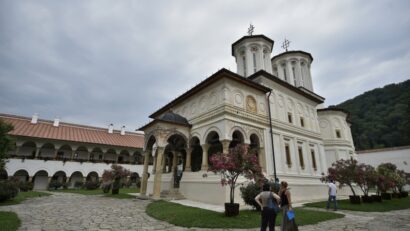
Today we will open the gates of the Harman citadel, in the locality of the same name. Our guide is Diners Petru, the curator of the site. He told us the citadel was built in the 13th century, initially by the Teutonic Knights, then by the Saxons who came as land farmers in Transylvania from the German state Mosel. The Turks, Tartars and Mongolians were plundering them repeatedly. That was precisely why…


“The surrounding walls are 12 meters high, two and a half meters thick, and inside, at the upper level, they had a wheel-shaped structure of defense corridors. On the outside, the citadel had a moat, a drawbridge and a safety grid. The rooms that can still be seen attached to the wall were food storage units, each family had such a room, and these rooms were surrounding the entire fortress. Some of these rooms were dismantled in 1848, and the building materials that were left were used to build a school, a nursery school and the parochial house. At that time the ground was leveled, and around the church emergency lodgings cropped up, intended for the town’s officials. This type of lodgings, located at the upper level and attached to the church, are to be found only in Harman.”


The big tower of the church is 52 meters tall, and is the highest in the Barsa Land. Close by, there are four other small towers surrounding it, which means that the locality was entitled to organize trials. Inside the citadel there is a beautiful 13th century fountain, made of stone, and which has water even today.
Diners Petru told us that this fortified church, that has never been conquered, was initially built in the Romanescque style, and later on it was turned into a Gothic-style settlement.


“The Saxons who came to Transylvania were Catholics, and after the Reformation they became Evangelical. As long as the church was catholic, it was painted on the inside as well as on the outside, but later on the Evangelists covered all the paintings. The citadel was never conquered by enemies until the 1848 revolution, but it was set ablaze many times. The biggest fire broke out in 1593, when the Wallachian ruler Michael the Brave, unable to conquer the citadel, set both the citadel and the village on fire. Here in the church, in the upper part, there was a plank ceiling, which was burned down, and two years later this Gothic vault was built. The benches in the church also date from 1595.”


The backless benches in the middle of the church were for the women, and the chairs with the back, on either side, were for the men. Women were placed in the middle to be protected by men, and their chairs had no back because of women’s traditional outfit. The traditional Saxon dress had a larger pleated skirt, and two long, embroidered ribbons. Women could not lean back so as not to rumple their skirts. Men were placed on the sides because they were closer to the doors. If the city was attacked, they were the first to come out of the church. The front benches, covered with carpets, were for the officials of the locality. The carpets are Oriental, Turkish, donated by various merchants from the 16th-17th century, as a sign of gratitude for having returned home safe from their business travels. In 1710, king Charles 12th of Sweden was defeated by Czar Peter the Great in Poltava. After pulling out from the region, he spent a week in this fortress. He then paid all his expenses to the community; he donated a small bag of ducats to the church. Part of this money served to buy the organ and the altar, in 1787, as Diners Petru told us:


‘’Two Saxons from the city of Brasov built the Baroque altar. The organ was built in situ by an Austrian and a Hungarian, and it is the second largest in the Tara Barsei region. The largest organs stand in the Black Church in Brasov. A small key lies in the middle of the organ, in its upper part. This is a symbol of the Harman commune. In 1914, the tower bells were taken down and melted to build canons that were used in the First World War. In 1923, 3 bells were brought from Vienna, one of which cracked during transport. This was buried in the churchyard.”


But the story of the Vienna bell did not come to its close at this point. Humidity accumulated in the church wreaked havoc, in 1969, due to the raised soil level, caused by the dismantling of houses after 1848. Headstones were discovered behind the church, of the priests who had served this community and of their families. It was then that the bell was unearthed as well. It was used to build a monument in front of the church, in 1973, in the memory of people who found their final rest on foreign lands. In 1996, marble plates were laid on the sides of the memorial, in honor of the soldiers killed during the Second World War, while others were placed on the back side, to commemorate the Saxons who died in Russia, after the war had finished.


There are always many tourists eager to visit the church. I asked Diners Petru, the curator of the fortified church in Harman, about the countries they come from:


“They come from all over the world. About 7 or 8 years ago, we received tourists from Alaska. But we’ve also seen people from New Zealand, Australia, Brazil, Argentina, Uruguay, Chile, Mexico, Canada and the US, as well as from all over Europe, Japan and Korea. Many of the tourists who have been here told me that a visit to this fortress is a must of any trip to Romania.’’


So, whenever you drive through Brasov, don’t forget to stop by the fortified church in Harman. And remember, participants in the contest organized by RRI in cooperation with the Romanian Television Corporation, which is called ‘’Brasov – from Corona to the Golden Stag’’, have the chance to win a holiday in this beautiful region.

A NEW RRI CONTEST - FROM CORONA TO THE GOLDEN STAG 18/03/2010
THE SAMBATA DE SUS MONASTERY 29/04/2010
”THE LEGENDS OF BUZĂU”, A NEW CONTEST ON RRI 05/11/2009
THE PIATRA CRAIULUI MASSIF 09/09/2010
THE OUTSKIRTS OF BUCHAREST 02/09/2010
EUROPEAN TOURISM WEATHERING THE CRISIS 26/08/2010
THE WINNERS OF THE COMPETITION “BRASOV -FROM CORONA TO THE GOLDEN STAG”
BRASOV'S OLD CITY CENTER 22/07/2010
RURAL TOURISM AND NATURAL LANDMARKS IN BERCA 29/07/2010
ADVENTURE TRAVEL IN BRASOV 01/07/2010
HOLIDAYS AND SPA TREATMENT ON THE ROMANIAN BLACK SEA COAST 24/06/2010
SUMMER IN THE DANUBE DELTA 17/06/2010
HOLIDAYS IN MARAMURES 03/06/2010
TOP 5 TOURIST ATTRACTIONS IN BRASOV 27/05/2010
HISTORICAL SITES IN BRASOV 20/05/2010
MUSEUMS IN BRASOV 13/05/2010
NATURAL ATTRACTIONS AROUND THE CITY OF BRASOV 06/05/2010
THE WINNERS OF THE ‘LEGENDS OF BUZAU’ CONTEST ON RRI 22/04/2010
CULTURAL TOURISM IN BRASOV (THE BRASOV PRIZE-WINNING CONTEST) 15/04/2010
EASTER IN BUCOVINA AND MARAMURES 01/04/2010
POIANA BRASOV 25/03 2010
RURAL TOURISM IN THE BARGAU MOUNTAINS 11/03/2010
NATURAL ATTRACTIONS IN BUZAU COUNTY 04/03/2010
SPAS IN THE VALCEA COUNTY 25/02/2010
MONASTERIES AND CITADELS IN BUZAU COUNTY 18/02/2010
WINTER ON THE PRAHOVA VALLEY 11/02/2010
MUSEUMS IN BUZAU COUNTY 04/02/2010
ON THE SKI SLOPES 28/01/2010
CHURCHES CARVED INTO THE MOUNTAIN 21/01/2010
SAXON FORTIFIED CHURCHES IN ROMANIA 14/01/2010
RURAL TOURISM AND NATURAL LANDMARKS IN BERCA 07/01/2010
A LOOK BACK AT TOURIST DESTINATIONS RRI PRESENTED IN 2009 31/12/2009
NEW YEAR’S EVE IN ROMANIA 24/12/2009
THE BUZAU MOUNTAINS 17/12/2009
RURAL TOURISM IN WINTER IN ROMANIA 10/12/2009
RURAL TOURISM IN CHIOJDU 03/12/2009
HUNTING IN ROMANIA 26/11/2009
RURAL TOURISM IN SARATA MONTEORU 19/11/2009
RURAL TOURISM IN LUNCA SIBIELULUI 12/11/2009
AUTUMN HOLIDAYS IN BORSA 29/10/2009
THE NARROW GAUGE TRAIN ON THE VASER VALLEY 22/10/2009
TOURIST ATTRACTIONS IN THE ARIESUL MIC VALLEY 08/10/2009
RURAL TOURISM IN BUKOVINA 24/09/2009
FELIX SPA 17/09/09
 
Bookmark and Share
WMA
64kbps : 1 2 3
128kbps : 1 2 3
MP3
64kbps : 1 2 3
128kbps : 1 2 3
AAC+
48kbps : 1 2 3
64kbps : 1 2 3
Listen Here
These are the hours when you can listen to the programmes broadcast by the English Service of RRI.
Time (UTC) 11.00 - 12.00
00.00 - 01.00 17.00 - 18.00
03.00 - 04.00 20.30 - 21.00
05.30 - 06.00 22.00 - 23.00


Historical mascot of RRI